
How Investors Can Understand and Apply the Burn Multiple
For startups, growth is only part of the equation. How much capital a company spends to achieve that growth can be just as important, particularly when outside funding becomes more difficult to obtain. A startup growing quickly while burning significant amounts of cash may be in a very different position than one achieving similar growth with less capital.
The burn multiple can help investors evaluate that difference by comparing a company’s net cash burn with its growth in recurring revenue. In this week’s blog, our team at MicroVentures is looking at how the burn multiple works, what can drive it higher or lower, and what investors should consider when using it to evaluate a startup.
What Is the Burn Multiple?
The burn multiple measures how much cash a company burns for each dollar of net new annual recurring revenue (ARR) it generates. It is most commonly used to evaluate recurring-revenue businesses, particularly software-as-a-service (SaaS) companies.
The calculation is relatively straightforward:
Burn Multiple = Net Cash Burn ÷ Net New ARR
Net cash burn generally refers to the amount of cash a company uses to fund operations over the measurement period, while net new ARR represents new and expansion ARR minus ARR lost to customer churn or contractions. Suppose a startup burns $4 million over a 12-month period and begins the year with $6 million in ARR. During the year, it adds $3 million of new and expansion ARR but loses $1 million to churn and contractions, bringing ending ARR to $8 million. The company therefore generated $2 million of net new ARR, for a burn multiple of 2.0x. In other words, it burned $2 for every $1 of net new ARR generated.
What Is a Good Burn Multiple?
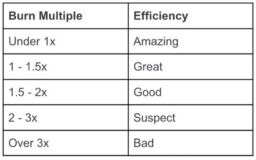
A commonly cited framework from venture capitalist David Sacks provides general benchmarks for interpreting the burn multiple. Under the framework, a multiple below 1.0x is considered strong, 1.0x to 2.0x indicates good capital efficiency, and multiples above 2.0x may warrant closer attention.[i] These benchmarks are not universal, however, as company stage, growth rate, margins, and investment cycle can all affect what an appropriate burn multiple looks like.
What Can a High Burn Multiple Signal?
A high burn multiple can indicate that a startup is spending aggressively relative to the growth it is producing. This could result from high sales and marketing costs, rapid hiring, inefficient customer acquisition, low gross margins, or operating expenses that have grown faster than revenue. It can also result from slowing net new ARR growth, which may reflect weaker new customer acquisition, lower expansion revenue, or higher churn and contractions.
A high burn multiple is not necessarily a sign that a startup is performing poorly. A company entering a new market, expanding its sales organization, or investing heavily in product development may temporarily burn more capital before those investments contribute to revenue. Investors may want to look at both sides of the calculation, including what is driving cash burn and what is affecting net new ARR.
When Can a Low Burn Multiple Be Misleading?
A low burn multiple generally looks attractive because it indicates that a company is generating net new recurring revenue without consuming significant amounts of cash. In some cases, however, the number may not tell the full story. A lower multiple may come at the expense of potential growth, depending on what is driving the improvement.
For example, a startup could improve its burn multiple by reducing hiring, marketing, or product investment while net new ARR remains unchanged. If a company generates $2 million of net new ARR while reducing annual cash burn from $4 million to $2 million, its burn multiple would improve from 2.0x to 1.0x. While the lower cash burn improves the metric, cutting investment too aggressively could limit the company’s ability to acquire customers, develop new products, or support future growth.
A low burn multiple can also result from rapid net new ARR growth while cash burn remains unchanged. If a company burns $2 million while net new ARR increases from $2 million to $4 million, its burn multiple would improve from 1.0x to 0.5x. While this reflects greater capital efficiency, if demand is growing quickly, keeping spending flat could mean passing up opportunities to invest in sales capacity, product development, or other areas that could support additional growth. A low burn multiple should therefore be considered alongside what is driving the underlying cash burn and ARR growth.
Growth and Capital Efficiency
One of the most useful ways to evaluate the burn multiple is alongside ARR growth. Consider two startups with a 1.5x burn multiple, but one is growing ARR by 80% annually while the other is growing by 15%. Both have the same relationship between cash burn and net new ARR, but one is expanding substantially faster.
Rapid growth may also be difficult to sustain if it requires increasingly large amounts of capital. As the business scales, investors can look at whether its growth is becoming more capital efficient or more expensive to generate.
The quality of ARR growth also matters. A favorable burn multiple may be less meaningful if the underlying ARR growth depends on aggressive discounting, comes with weak gross margins, or masks high customer churn. Retention, customer acquisition costs, and revenue quality can provide a more complete picture of whether that growth is sustainable.
What Is Driving the Burn?
Investors should consider where a company’s capital is being spent and whether the spending is temporary or structural. Investments in product development, infrastructure, or geographic expansion may increase burn in the short term but support future growth. By contrast, persistently high customer acquisition costs, weak gross margins, or growing overhead may be more difficult to improve.
Burn Multiple and Runway
Capital efficiency becomes particularly important when considered alongside a startup’s cash runway. A company with a high burn multiple and limited cash may need to raise capital before it has demonstrated enough progress to support favorable financing terms.
If ARR growth falls below expectations while spending remains high, the company could reach the fundraising market with less growth and less cash than originally planned. A more capital-efficient business may have greater flexibility to extend runway or delay a financing, particularly if it can maintain growth without materially increasing spending. For investors, understanding the relationship between burn, growth, and runway can help indicate how dependent a startup may be on future outside capital.
Looking Beyond a Single Period
Like many startup metrics, the burn multiple is more useful when tracked over time. A single quarter can be affected by large customer contracts, annual expenses, hiring patterns, or other timing differences that distort the calculation.
Evaluating the metric across several quarters or on a trailing 12-month basis can provide a clearer picture. An improving burn multiple alongside continued ARR growth may indicate that a company is gaining operating leverage as it scales. A steadily worsening multiple, particularly alongside slowing growth, may warrant closer attention.
Investors can also compare actual performance with management’s forecasts. Consistently burning more cash or generating less net new ARR than projected may reveal issues with budgeting, sales execution, or the assumptions underlying the company’s growth plan.
Final Thoughts
The burn multiple provides a relatively simple way to evaluate the relationship between a startup’s spending and its net new ARR growth. However, the metric is most useful when viewed in context. Company stage, growth rate, gross margins, spending priorities, and runway can all influence what an appropriate burn multiple looks like.
Investors can also look at how the metric changes over time and whether current spending is translating into sustainable growth. The burn multiple does not determine whether a startup is a good investment, but it can help investors understand how efficiently the company is turning capital into recurring ARR growth.
Are you ready to invest in startups? Sign up for a MicroVentures account to start investing!
Want to learn more about investing in startups? Check out the following MicroVentures blogs to learn more:
- Investing in Second-Time Founders
- Why Churn Matters More Than New Customers in SaaS
- Developing Your Investment Thesis
- Learning From Failed Startups
[i] https://www.wallstreetprep.com/knowledge/burn-multiple/#:~:text=What%20is%20a%20Good%20Burn%20Multiple%20for%20SaaS%20Companies%3F
Important disclosure
The information presented here is for general informational purposes only and is not intended to be, nor should it be construed or used as, comprehensive offering documentation for any security, investment, tax or legal advice, a recommendation, or an offer to sell, or a solicitation of an offer to buy, an interest, directly or indirectly, in any company. Investing in both early-stage and later-stage companies carries a high degree of risk. A loss of an investor’s entire investment is possible, and no profit may be realized. Investors should be aware that these types of investments are illiquid and should anticipate holding until an exit occurs.