Trying to grow a startup without tracking costs can be difficult, especially when a startup has limited cash. Instead, startups should consider managing their customer acquisition costs to help make more informed spending decisions and allocate budgets efficiently. In this blog, learn more about the fundamentals of customer acquisition cost, how to calculate it, why it’s important for startups to understand, and some benefits of managing the cost.
Understanding Customer Acquisition Cost
Customer acquisition cost, or CAC, measures how much an organization spends to obtain a new customer. This metric generally includes marketing and sales expenses like ad spend, production costs, employee salaries, and anything needed to convince a customer to buy a product or service. Ultimately, customer acquisition cost can be used to evaluate how efficient a startup is at gaining new customers.
How to Calculate CAC
To calculate customer acquisition cost, identify a period of time, like a specific month, and divide the total expenses to acquire customers (cost of marketing and sales) by the total number of customers acquired during that same time period.
Customer Acquisition Cost = Total Costs / Number of Customers Acquired
For example, if a startup spent $100,000 on acquisition efforts in a month and gained 200 new customers during that month, CAC would be $500 per customer:
$500 = $100,000 / 200
Why CAC can be Important
Although CAC might seem like just crunching numbers, this metric can be about how the numbers carry meaning in understanding a company’s potential path to scale.
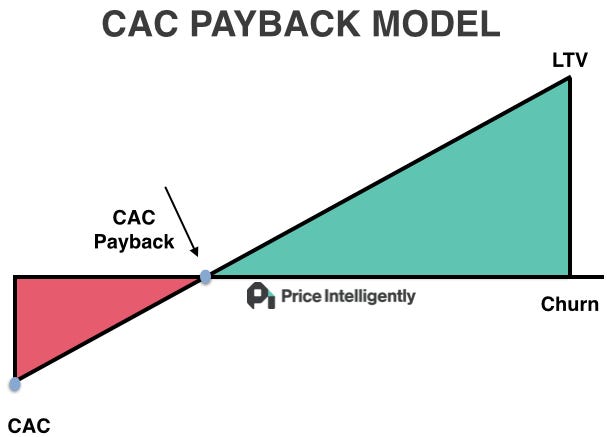
This path is illustrated in the above figure; the early period of the acquisition process (highlighted in red) is where a business is spending time and money. As time passes and a customer starts to pay for services, the startup may eventually recover the initial investment and reach a breakeven point. From there (highlighted in green), the startup may reach a profit from that customer until that customer decides to stop using the service.
Additionally, understanding CAC can be important for:
Attracting Investors
Potential investors may look at a startup’s CAC to determine if the startup is actively managing these costs. A well-managed CAC could indicate efficient customer acquisition, helping an investor assess the company’s growth strategy.
Benchmarking for Goals and Growth
Because CAC typically fluctuates, it can be important to benchmark CAC over specific periods of time like months, quarters, and years. The earlier CAC is measured, the more detailed insights may be, allowing a startup to set targeted goals. As the volume of data grows, startups may want to update and optimize channels and tactics as needed.
Ways to Reduce CAC
Startups can use several strategies to help reduce customer acquisition costs by understanding customer segments and optimizing marketing and sales resources to potentially get more customers from the same marketing spend.
Understand Customer Segments
Identifying customers’ wants and needs, or common traits across segments, can lead to efficiencies in product development and marketing messaging, helping allow a startup to shift spending, which can help lower CAC. Improving conversion rates can further reduce CAC by converting more visitors or leads into potential paying customers through strategies such as A/B testing, implementing call-to-action buttons, and utilizing social proof, including testimonials.
Final Thoughts
Tracking customer acquisition cost can help organizations better understand how much money is spent to acquire one customer and establish a benchmark that can be tracked and evaluated over time. This metric may also help identify opportunities for improvement by understanding customer segments and optimizing marketing and sales efforts to potentially reduce customer acquisition cost.
Are you ready invest in startups? Sign up for a MicroVentures account to start investing!
Want to learn more about scaling a startup? Check out the following MicroVentures blogs to learn more:
- Building a Strong Investor Network
- Deciding How Much to Raise
- From Prototype to Product-Market Fit: Seed vs Series A Funding
- Keeping a Startup Alive Between Funding Rounds
Important disclosure
The information presented here is for general informational purposes only and is not intended to be, nor should it be construed or used as, comprehensive offering documentation for any security, investment, tax or legal advice, a recommendation, or an offer to sell, or a solicitation of an offer to buy, an interest, directly or indirectly, in any company. Investing in both early-stage and later-stage companies carries a high degree of risk. A loss of an investor’s entire investment is possible, and no profit may be realized. Investors should be aware that these types of investments are illiquid and should anticipate holding until an exit occurs.