
Behind The Biotech Bounce: Why 2026 Is Turning into a Standout Year
After years of capital constraints and selective funding, 2026 appears to be shaping up as a breakout year for biotech particularly for artificial intelligence (AI) biotech companies pushing the frontier of synthetic biology, genomic analysis, and cellular engineering. The convergence of three forces – a recovering venture market, regulatory tailwinds, and the maturation of AI-driven biotech tools – is helping to create a potential opportunity for investors seeking exposure to the next generation of biological innovation.
The Market Recovery
In the years after the 2021 peak, biotech venture funding declined as broader venture capital conditions tightened and investors grew cautious about long-duration biotech .[i] Many founders faced extended fundraising timelines and compressed valuations. According to J.P. Morgan, biopharma venture funding fell from a peak of $45.3 billion in 2021 to $22.7 billion in 2023, a decline of nearly half. Funding showed signs of recovery, reaching $26.5 billion in 2024, and grew to $29.1 billion in 2025.[ii]
Data from 2026 suggest momentum may be continuing. J.P. Morgan reported $16.3 billion in biopharma venture funding across 235 rounds in the first half of 2026. On an annualized basis, that would equal roughly $33 billion for the full year, about 13% more than the 2025 total, though first-half results may not hold for the rest of the year.[iii] Over the same period, 13 initial public offerings (IPOs) raised $5 billion, more than any full year from 2022 through 2025.[iv]
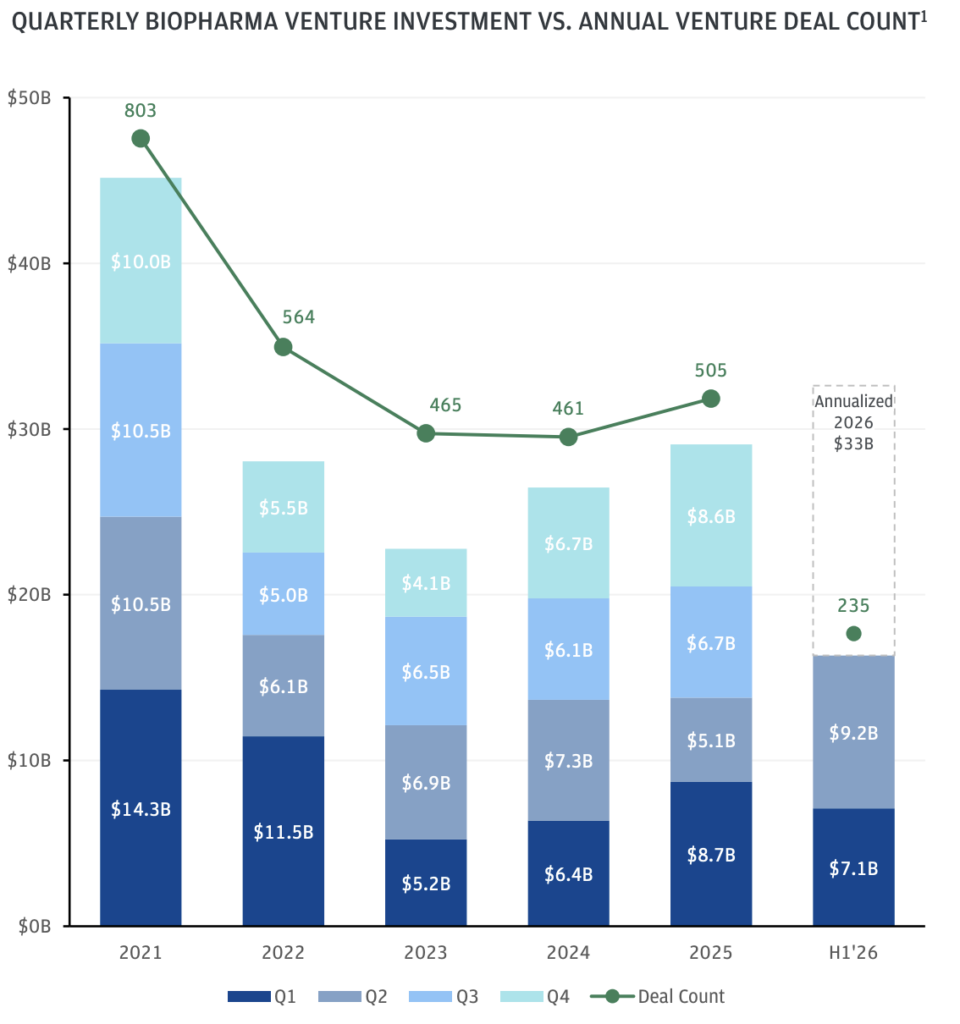
The rebound has generally favored more mature companies. Seed and Series A financing has reportedly fallen to its lowest level in years.[v] About two-thirds of venture rounds in the first half of 2026 went to companies that already had a drug candidate in human testing. A single $2.1 billion round for AI drug discovery company Isomorphic Labs also accounted for a meaningful share of the total.[vi] For investors, this could mean the biotech sector recovery looks different depending on a company’s stage. Late-stage startups may be seeing renewed demand, while earlier companies could still face a challenging fundraising environment.
Regulatory Wins Are Fueling Confidence
Beyond capital availability, regulatory approval milestones are restoring investor confidence in the space. The FDA has accelerated approvals for several high-profile biotech therapies, signaling clearer pathways for companies in adjacent areas. Cell therapy, gene editing, and personalized medicine have all seen recent wins that validate the underlying science and reduce perceived regulatory risk.
These successes matter because they shift perception. When biotech founders can point to regulatory precedent and approved therapies in adjacent spaces, investor confidence in their timelines and exit potential can increase. The approval landscape of 2026 is materially different from 2023, and that difference is reflected in renewed appetite for biotech funding.
How AI Biotech Companies Are Accelerating Biology
The most exciting development is the rise of AI biotech companies, firms applying large language models, machine learning, and agentic AI systems to accelerate discovery, design, and validation in biology. These companies are not just applying AI as a tool; they’re fundamentally reshaping how biology research and development happens.
Colossal Biosciences
Consider Colossal Biosciences, one of the world’s first de-extinction companies using advanced genetic engineering, AI-driven genome analysis, and stem cell reprogramming to combat biodiversity loss. The company has reported partnerships focused on endangered species.
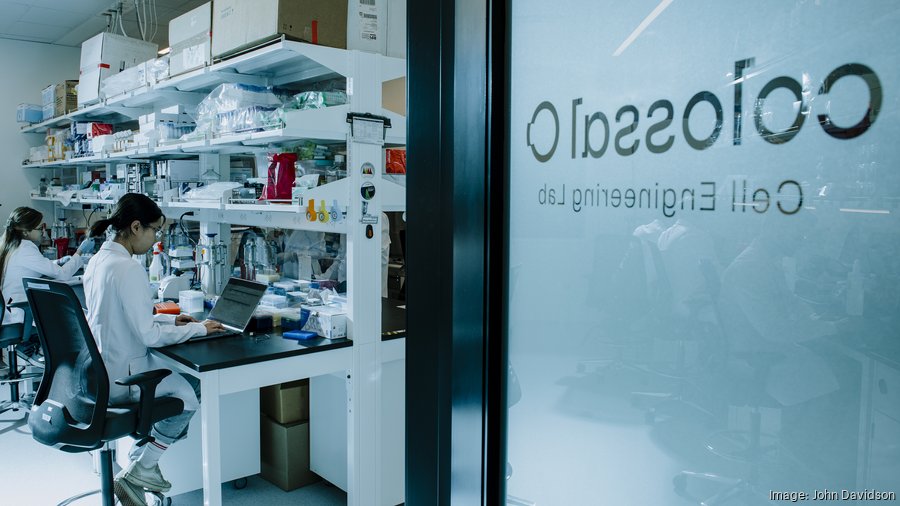
According to Axios, Colossal was in talks in July 2026 to raise capital at a valuation of $20 billion to $30 billion, up from $10.2 billion in early 2025.[vii] The company has also spun out several businesses. These include Form Bio, a computational biology company, and Astromech, an AI-driven biological modeling company that was reportedly valued at $2 billion in March 2026.[viii]
Persephone Biosciences
Persephone Biosciences offers a different example. The San Diego-based synthetic biology company is developing microbiome-based products for patient and infant health.[ix] Its ARGONAUT study is designed to enroll up to 5,000 advanced-stage cancer patients. The study collects stool and blood samples that may help the company develop precision microbiome medicines and identify cancer-specific biomarkers.[x] Persephone has said it uses machine learning to analyze this data as it works toward microbial therapeutics.[xi]

The potential appeal of AI-native approaches is that they could help compress research timelines, reduce screening costs, and open up design possibilities that may have been difficult to reach through traditional lab work alone. Synthetic biology and drug development are two areas where this could matter. If those advantages hold up, some companies may be able to reach key milestones faster than traditional biotech peers.
What Investors Should Watch
AI biotech companies are not all positioned equally. Investors may want to look for companies that can translate AI capabilities into measurable biological results that are validated in the lab and capable of moving through regulatory pathways. The following factors may help with that assessment.
Scientific Validation: Investors may want to consider whether a company has peer-reviewed publications or data suggesting its AI-driven approach performs better than traditional methods. Claims of a technical advantage can generally be more convincing when backed by evidence.
Team Depth: A strong team typically includes both AI and machine learning researchers and experienced biologists. Companies missing one side of that expertise may face challenges in turning models into usable science.
Path to Revenue: Investors may want to understand whether the company is targeting research tools, therapeutics, agricultural applications, or synthetic biology services. Early revenue or clear customer demand could indicate commercial validation.
Capital Efficiency: Computational approaches may allow some companies to accomplish more with less capital. A burn rate that seems high relative to the company’s progress could be worth a closer look. This is often part of evaluating a startup’s planned use of funds.
Recent momentum in biotech may not be evenly distributed across the sector. Investors may want to consider looking closely at how AI is actually being applied within a company’s research and development process, as distinguishing substantive innovation from hype can be an important part of evaluating opportunities in this space.
Final Thoughts
Biotech funding has shown signs of recovery in 2026, supported by stronger venture and IPO activity and recent regulatory milestones, though capital has largely concentrated in later-stage companies. AI biotech companies may be positioned to benefit from this environment if they can turn computational advantages into validated biological results. Scientific validation, team depth, a path to revenue, and capital efficiency can serve as useful signals for investors evaluating companies in this space.
Are you ready to invest in startups? Sign up for a MicroVentures account to start investing!
Want to learn more about investing in startups? Check out the following MicroVentures blogs to learn more:
- How to Evaluate a Startup’s Competitive Moat
- Primary vs Secondary Investing
- Evaluating a Startup’s Use of Funds
- Building a Diversified Startup Portfolio
Sources
- [i]fortrea.com — https://www.fortrea.com/insights/biotech-funding-challenges
- [ii]jpmorgan.com — https://www.jpmorgan.com/content/dam/jpmorgan/documents/cb/insights/outlook/jpm-biopharma-deck-q2-2026-2.pdf
- [iii]jpmorgan.com — https://www.jpmorgan.com/content/dam/jpmorgan/documents/cb/insights/outlook/jpm-biopharma-deck-q2-2026-2.pdf
- [iv]jpmorgan.com — https://www.jpmorgan.com/insights/markets-and-economy/outlook/biopharma-medtech-deal-reports
- [v]synbiobeta.com — https://www.synbiobeta.com/read/quarterly-biotech-funding-continues-upward-in-q2-of-2026-trend-with-4th-straight-quarter-of-growth
- [vi]biopharmadive.com — https://www.biopharmadive.com/news/biotech-venture-capital-funding-2026-first-half/824881/
- [vii]axios.com — https://www.axios.com/2026/07/20/wooly-mammoth-colossal-20-billion
- [viii]dealroom.co — https://dealroom.co/news/140079-colossal-biosciences-in-talks-to-raise-at-up-to-30b-tripling-its-valuati/
- [ix]businesswire.com — https://www.businesswire.com/news/home/20220719005509/en
- [x]clinicaltrials.gov — https://clinicaltrials.gov/study/NCT04638751
- [xi]sdbj.com — https://www.sdbj.com/life-sciences/biotech-life-sciences/persephone-lands-15m-seed-for-microbiome-platform/
Important disclosure
The information presented here is for general informational purposes only and is not intended to be, nor should it be construed or used as, comprehensive offering documentation for any security, investment, tax or legal advice, a recommendation, or an offer to sell, or a solicitation of an offer to buy, an interest, directly or indirectly, in any company. Investing in both early-stage and later-stage companies carries a high degree of risk. A loss of an investor’s entire investment is possible, and no profit may be realized. Investors should be aware that these types of investments are illiquid and should anticipate holding until an exit occurs.