
Founder Secondaries: What Early Liquidity Can Signal
Founders are holding their shares longer than ever, and many may eventually want to turn a portion of that paper wealth into cash before an exit. When news breaks that a founder has sold stock in a private company, investors may be left wondering whether the sale reflects healthy financial planning or a lack of confidence in the business. In this blog, learn more about founder secondaries, why they have become more common, and some signals investors may want to watch for when evaluating early liquidity.
What Is a Founder Secondary?
A founder secondary is a sale of shares a founder already owns to another investor. Unlike a primary round, where a startup issues new shares to raise capital, a secondary sale does not put any money into the company’s bank account. Ownership simply changes hands, which can reshape the cap table without changing the balance sheet.
These sales can happen directly between a founder and a buyer, or through a tender offer, where the company invites a group of shareholders to sell at a set price. Companies often limit how much stock a founder can sell at once, sometimes to roughly 10% to 25% of the founder’s vested shares, and a sale generally needs board approval and must clear a right of first refusal. Buyers typically expect a discount of about 10% to 30% below the most recent valuation, since they are purchasing common stock that usually comes without a board seat, information rights, and liquidation preference. In weaker markets, those discounts can widen further. During the 2022 and 2023 downturn, discounts on some late-stage names grew beyond 40%, according to Forge Global data.[i]
Why Founder Liquidity Has Become More Common
Startups are staying private longer than ever, and traditional exits have remained difficult to reach in some parts of the market. For founders of early-stage and late-stage startups, this can mean a significant share of their net worth is tied up in a single illiquid asset.
Investor attitudes have shifted as well. Founders were once discouraged from selling equity in their private companies out of concern it could misalign interests, but some investors now argue founders may stay more focused when they are not worried about expenses like mortgages and car payments. Under this view, a modest sale could make a founder more willing to pursue a larger long-term outcome rather than accept an early acquisition offer.
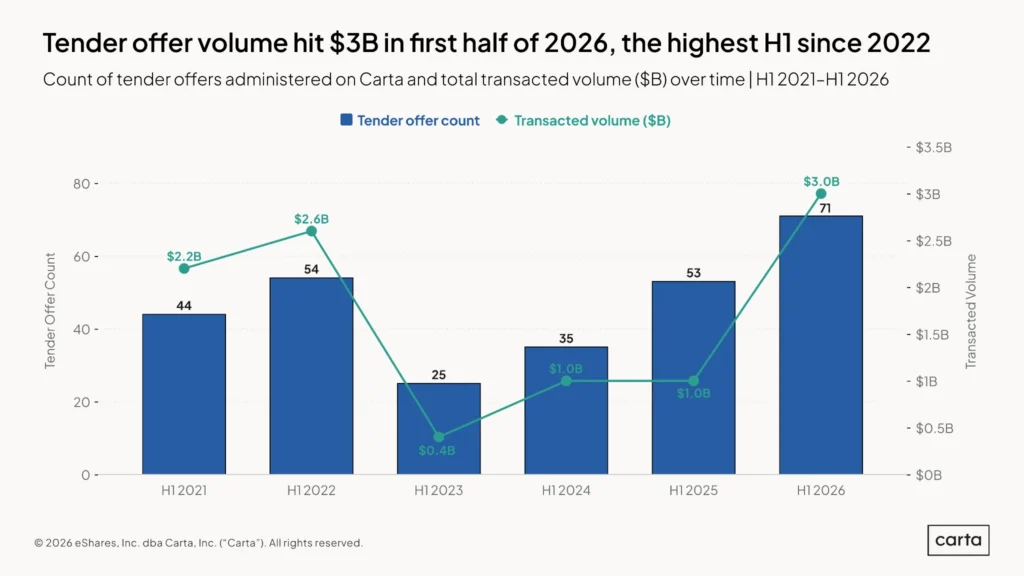
Company-run tender offers, one common path to liquidity, have also grown. Carta administered 71 tender offers in the first half of 2026 with a combined volume of about $3 billion, the highest first-half totals in at least six years. Dollar volume tripled from the first half of 2025 and rebounded from a low of $400 million in the first half of 2023.[ii]
When Early Liquidity May Signal Confidence
The Sale Is Modest Relative to Holdings
When a founder sells a small portion of their shares and keeps the majority, the sale may suggest they still expect most of their wealth to come from the company’s future growth. A sale that stays well within the limits many companies place on founder sales, rather than pressing against them, may be less likely to raise concerns.
Pricing Holds Near the Last Round
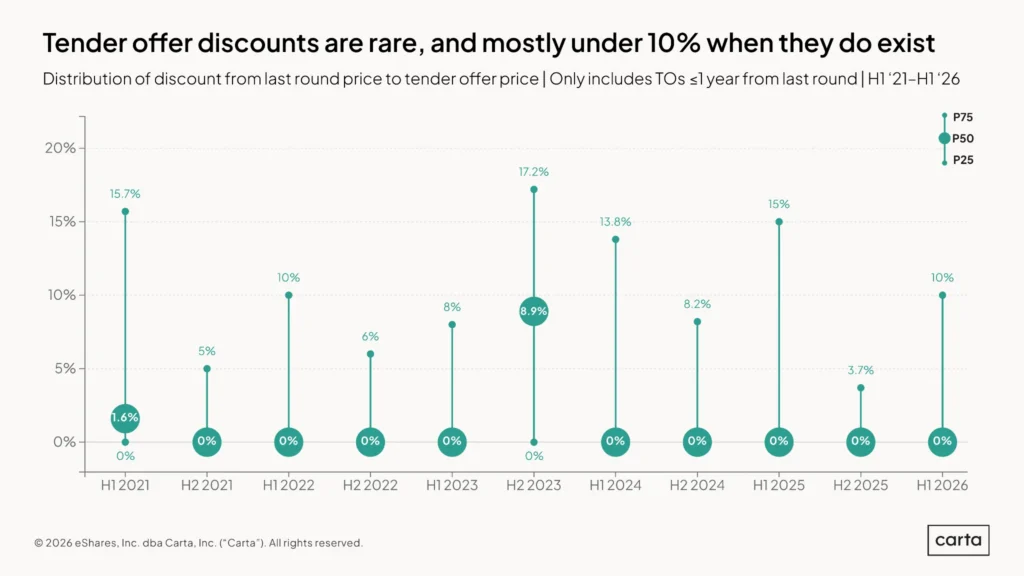
Price can also be informative. If buyers are willing to pay at or near the company’s most recent valuation, it could indicate healthy demand for the shares. Across the broader market, discounts have been uncommon in tender offers. According to Carta, the median discount relative to the last round has been 0% for five straight semiannual periods, though at least a quarter of those in the first half of 2026 carried a discount of 10% or more.[iii]
Liquidity Is Shared Broadly
Sales that include employees tend to be viewed more favorably than those limited to founders. Voice artificial intelligence (AI) startup ElevenLabs completed a $300 million employee tender offer in September at a $22 billion valuation, double the $11 billion valuation from its $500 million Series D round in February.[iv] The move reflects a broader trend of fast-growing AI startups using employee liquidity to keep staff from leaving for competitors. It was the company’s second employee tender in about a year, following a $100 million sale at a $6.6 billion valuation in September 2025.[v]
When Early Liquidity May Raise Questions
Size and Timing
Large sales shortly before an initial public offering may raise concerns. WeWork co-founder Adam Neumann reportedly cashed out more than $700 million through a combination of stock sales and loans before the company’s planned public offering, with roughly $300 million of that coming from stock sales.[vi] The size and timing of those transactions drew scrutiny as the company prepared to go public.
Founder-Only Windfalls Near a Peak
Hopin founder Johnny Boufarhat reportedly sold $195 million of stock just two years before the company’s assets were sold for a small fraction of its $7.7 billion peak valuation.[vii] A sale at a high valuation does not necessarily mean a founder anticipated a decline, but it could leave the founder with less exposure to the downside than other shareholders.
Steep Discounts
A founder accepting a steep discount could indicate weaker demand for the company’s shares, particularly when most recent tender offers have priced at or near the last round. A deep discount is not always a warning sign, since broader market conditions may be a factor, as they were in the 2022 and 2023 downturn, but investors may want to understand the context behind the price.
Questions Investors May Want to Ask
As part of their due diligence, investors may want to consider how much a founder sold relative to their total holdings, and at what price compared to the most recent round. Who purchased the shares, and whether employees or other shareholders were offered the same opportunity, can also be informative. For investors considering a secondary investment themselves, similar questions may apply, since the seller on the other side of a transaction could be a founder, an early employee, or an early investor.
Investors may also want to look at whether the founder is still vesting and remains operationally involved. Companies that disclose secondary activity in their investment updates may offer more transparency, though not every private company shares these details.
Final Thoughts
Founder secondaries are not inherently positive or negative. A modest sale at a fair price, especially one that includes employees, could reflect sound financial planning, while large or poorly timed founder-only sales may raise questions. Looking at size, pricing, participation, and timing together can help investors form their own view of what early liquidity may signal.
Are you ready to invest in startups? Sign up for a MicroVentures account to start investing!
Want to learn more about investing in startups? Check out the following MicroVentures blogs to learn more:
- What Happens When a Startup is Acquired Before an IPO?
- Navigating Startup Exits
- How the Secondary Market Became a $106 Billion Opportunity in Startup Investing
- Why Companies Are Staying Private Longer and What It Means for Investors
- The Megaround Era: What Larger Funding Rounds May Mean for Private Market Investors
Sources
- [i]startupfortune.com — https://startupfortune.com/how-do-founder-secondary-sales-actually-work-before-an-exit/
- [ii]carta.com — https://carta.com/data/tender-offer-update-h1-2026/
- [iii]carta.com — https://carta.com/data/tender-offer-update-h1-2026/
- [iv]live.euronext.com — https://live.euronext.com/en/financial-news/elevenlabs-valuation-doubles-22-billion-surging-ai-voice-agent-demand
- [v]techcrunch.com — https://techcrunch.com/2026/02/05/secondary-sales-shift-from-founder-windfalls-to-employee-retention-tools/
- [vi]axios.com — https://www.axios.com/2019/07/19/behind-wework-founders-700m-cash-out
- [vii]techcrunch.com — https://techcrunch.com/2026/02/05/secondary-sales-shift-from-founder-windfalls-to-employee-retention-tools/
Important disclosure
The information presented here is for general informational purposes only and is not intended to be, nor should it be construed or used as, comprehensive offering documentation for any security, investment, tax or legal advice, a recommendation, or an offer to sell, or a solicitation of an offer to buy, an interest, directly or indirectly, in any company. Investing in both early-stage and later-stage companies carries a high degree of risk. A loss of an investor’s entire investment is possible, and no profit may be realized. Investors should be aware that these types of investments are illiquid and should anticipate holding until an exit occurs.