
Dissecting the Anthropic S-1
Since its founding in 2021, Anthropic has become one of the most closely watched private companies in artificial intelligence (AI). On October 26, 2026, the company filed its S-1 registration statement with the U.S. Securities and Exchange Commission (SEC), taking a significant step toward an initial public offering (IPO). The filing provides insight into Anthropic’s rapid revenue growth, financial performance, and substantial commitments to AI infrastructure.
The company plans to list on the Nasdaq Global Select Market under the ticker symbol “ANT.” An S-1 is a registration statement that provides investors with information about a company’s business, financials, and risks ahead of an IPO. In this blog, learn more about this MicroVentures portfolio company, what the filing reveals, and what investors may want to consider.
What Is Anthropic?
Founded in 2021 and headquartered in San Francisco, Anthropic is a Delaware public benefit corporation, a for-profit corporate structure that requires the company to balance stockholder interests with a stated public benefit. Anthropic’s stated purpose is the responsible development and maintenance of advanced AI for the long-term benefit of humanity. Its business is built around Claude, its family of frontier AI models, which it sells through several products:
- Claude Platform: Developer tools and application programming interface (API) access for building on Claude
- Claude Code: A coding agent that plans, writes, tests, and debugs software
- Claude Cowork: An agent that extends the Claude Code approach to broader knowledge work, reading files and running multi-step workflows on a user’s desktop
Usage-based fees, metered by how much customers use Claude, accounted for 80% of revenue in the first half of 2026, with subscriptions making up the remaining 20%. The models are available on Amazon Web Services (AWS), Google Cloud, and Microsoft Azure. Anthropic does not report separate business segments, making revenue growth and the cost of the computing infrastructure supporting its models particularly important measures of its financial performance.
Anthropic’s Financial Performance
Anthropic’s financial results show rapid revenue growth and improving operating performance, alongside substantial net losses driven largely by non-cash accounting charges.
For the full year 2025, Anthropic reported:
- Revenue: $4.6 billion, up from $386 million in 2024
- Operating loss: $8.1 billion, including a one-time $1.5 billion copyright settlement, compared with approximately $3.0 billion in 2024
- Net loss: $42.0 billion, up from $8.3 billion in 2024
For the six months ended June 30, 2026, Anthropic reported:
- Revenue: $16.3 billion, up from $1.2 billion in the same period of 2025
- Operating loss: $693 million, compared to $2.1 billion in the same period of 2025
- Adjusted operating income: $1.6 billion, a 10% adjusted operating margin, compared with an adjusted operating loss of $1.9 billion in the same period of 2025
- Net cash provided by operating activities: $3.9 billion, compared with an outflow of $1.5 billion in the same period of 2025
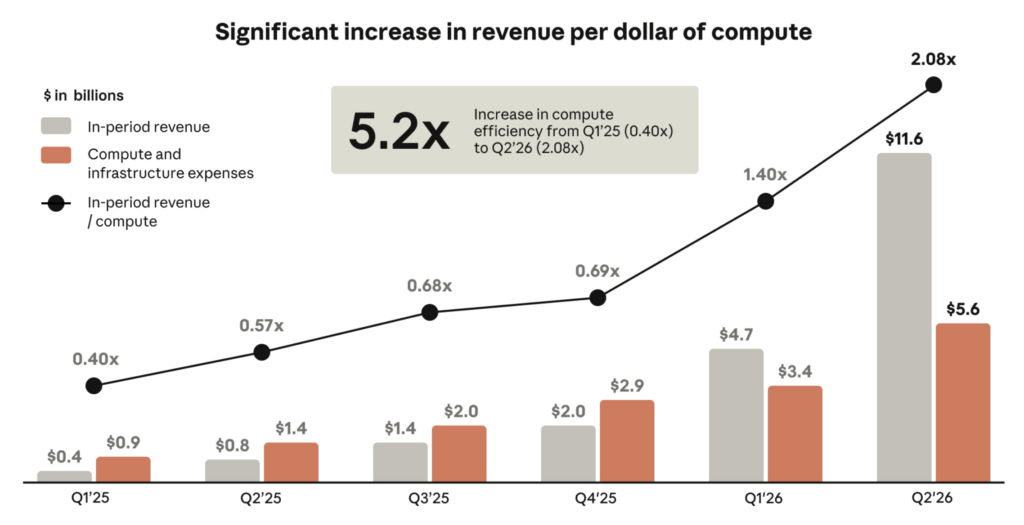
Revenue growth has outpaced growth in compute and infrastructure expenses, contributing to improved operating performance. According to the filing, revenue grew 1,368% year over year in the quarter ended June 30, 2026, while compute and infrastructure expenses grew 300%. Compute is still the largest expense, at about $9.0 billion in the first half of 2026 compared with $7.3 billion for all of 2025.
Quarterly results reflect this trend. Revenue rose from $4.7 billion in Q1 2026 to $11.6 billion in Q2 2026, while Anthropic reported $974 million in operating income, compared with a $1.7 billion operating loss in the previous quarter. Compute and infrastructure expenses fell from 177% of revenue in Q2 2025 to 48% in Q2 2026, suggesting Anthropic is generating more revenue from each dollar of compute, though the S-1 notes margins may compress as large amounts of new compute come online ahead of the revenue it supports. The chart below shows revenue per dollar of compute rising 5.2x, from 0.4x in Q1 2025 to 2.08x in Q2 2026.
More recent, unaudited results suggest this momentum continued into the third quarter. According to reports of an October 2026 presentation to prospective investors, Anthropic generated $16.8 billion in Q3 revenue, up approximately 45% from $11.6 billion in Q2. The company also reportedly reported an adjusted operating margin above 11% and positive free cash flow. These figures are based on accounts from people familiar with the presentation, are unaudited, and were not included in the S-1.
Understanding Anthropic’s Net Loss
The $80.7 billion net loss for the first half of 2026 is the headline figure, but most of it is non-cash. According to the S-1, $72.4 billion came from changes in the fair value of convertible notes, derivative liabilities, and simple agreements for future equity (SAFEs), primarily driven by the rising value of its convertible promissory notes as the company’s valuation increased. Another $8.7 billion was recorded as other expense, a majority of which is tied to the recognition and change in fair value of other financial instruments.
The same dynamic shaped 2025, when $34.3 billion of the $42.0 billion net loss came from fair value adjustments. Because these charges are non-cash, the reported losses do not reflect the company’s cash spending or operating performance.
Enterprise Adoption Drives the Growth
As of September 30, 2026, according to the filing:
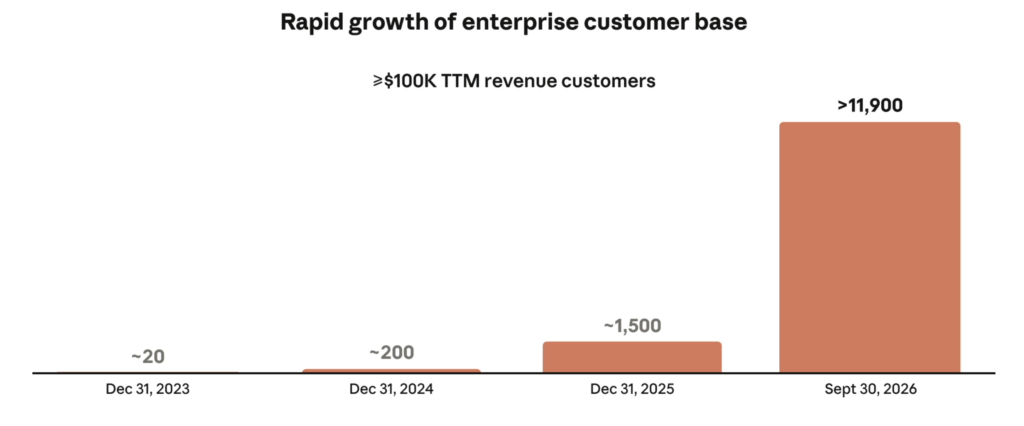
- Customers generating $100,000 or more in trailing 12-month (TTM) revenue: more than 11,900, up from more than 950 a year earlier
- Customers generating $1 million or more: more than 1,900
- Customers generating $10 million or more: approximately 250
- Net Revenue Retention: approximately 900%, excluding consumer subscription plans, reflecting expansion among existing customers
The chart below shows how quickly that customer base has grown since 2023.
Customer concentration has declined as Anthropic’s customer base has expanded. Approximately 79% of third-quarter 2026 revenue came from customers outside its five largest, compared with approximately 64% in the first quarter. However, the top 5 customers still represented approximately 25% of revenue in the nine months ended September 30, 2026. As its enterprise base grows, Anthropic is making substantial investments in computing infrastructure to support demand.
Anthropic Invested in Compute
If enterprise demand is the engine, compute is the fuel. The S-1 describes several of Anthropic’s largest compute arrangements:
- Broadcom: Approximately $160 billion in equipment lease commitments to provide compute capacity
- SpaceXAI: Up to $120.5 billion over terms extending into 2029
- Google: At least $114.5 billion in committed spending between April 2026 and July 2033, plus an estimated $125 billion to $150 billion in additional tensor processing unit (TPU) compute spending across providers, including Google, between 2028 and 2031
- Amazon: At least $110 billion between May 2026 and April 2036
- Microsoft: At least $44.9 billion between November 2026 and May 2033
- Nscale: Up to approximately $44.6 billion over terms extending into 2033
- AMD: Expected to exceed $20 billion if the full initial capacity of AMD Helios rack-scale systems is procured
The disclosed arrangements represent hundreds of billions of dollars in potential compute spending, although the agreements differ in their minimum commitments, maximum values, and purchasing conditions. The total aggregate commitment figure remains blank in the preliminary filing, and Anthropic expects to incur its committed compute arrangements through 2045.
While using AWS Trainium chips, Google TPUs, NVIDIA graphics processing units (GPUs), and AMD GPUs may reduce reliance on any single supplier, these arrangements also carry financial risks. Certain commitments with Google, Amazon, and Microsoft require payment regardless of actual usage, potentially creating financial pressure if customer demand falls short of expectations. Managing these obligations while scaling infrastructure to meet demand will remain an important consideration as Anthropic grows.
Market Opportunity
Anthropic does not give a single total addressable market (TAM) figure. Instead, the S-1 frames the opportunity around knowledge work:
- Knowledge work: more than $40 trillion in economic value globally in 2025, per the company’s estimate based on global wage data
- AI’s economic impact: International Data Corporation (IDC) estimates that investment in AI solutions and services will yield a cumulative global economic impact of $22.5 trillion by 2031
These figures illustrate the potential scale of the market opportunity but should not be interpreted as forecasts of Anthropic’s future revenue. The filing itself notes that adoption across the global economy remains nascent.
Recent Developments
The filing also highlights several recent developments that could influence Anthropic’s business and future growth.
The SpaceXAI Compute Deal Has Grown
When SpaceX filed its S-1 in May 2026, it disclosed that Anthropic agreed to pay $1.25 billion per month for compute through May 2029. Anthropic’s filing shows the relationship has since expanded. Between May and October 2026, Anthropic entered into and amended several agreements with SpaceXAI totaling up to $120.5 billion, or approximately $3.1 billion per month once all capacity is delivered, which it expects in December 2026. After initial non-cancelable periods ending in January and March 2027, either party may cancel on 90 days’ notice.
Anthropic’s Legal Dispute with the Department of War
In February 2026, after Anthropic said its technology should not be used for mass domestic surveillance or fully autonomous weapons, the President directed federal agencies to stop using its technology, and the Department of War moved to designate the company a “supply-chain risk to national security.” On August 27, 2026, a federal court in Northern California largely ruled in Anthropic’s favor, finding the actions retaliatory and unconstitutional. However, on September 25, 2026, the D.C. Circuit Court of Appeals upheld a separate supply-chain risk designation in a 2-1 decision, finding Anthropic’s First and Fifth Amendment rights were not violated. Anthropic has petitioned for a rehearing by the full court, leaving the dispute unresolved.
Anthropic Introduces Mythos
In April 2026, Anthropic introduced Mythos through Project Glasswing, a limited research preview focused on cybersecurity applications. Access was restricted to select organizations because of the model’s advanced vulnerability-discovery capabilities. Anthropic subsequently released Mythos 5.1 in September 2026. The filing acknowledges that such safety measures could slow development relative to competitors operating under fewer restrictions.
Key Risks for Investors
The S-1 contains a long list of risk factors, but several stand out for investors.
Compute obligations are fixed, but revenue is not. Many compute commitments must be paid regardless of usage, while 80% of first-half 2026 revenue was consumption-based and can fall if customers cut back or shift to cheaper models.
Additional share issuances could dilute shareholders. Note purchase agreements with Google, Amazon, and Broadcom, Google’s option to buy up to $10.0 billion of Class N stock alongside the IPO, and AMD’s commitment to buy up to $5.0 billion of Class N stock as deployment milestones are met could all result in additional equity issuance.
Cloud partners are also competitors. About 48% of first-half 2026 revenue came through the Amazon, Google, and Microsoft cloud marketplaces, and those partners also offer competing AI models.
Legal and regulatory risk remains significant. Beyond the $1.5 billion copyright settlement and the Department of War appeal, the U.S. Department of Commerce imposed worldwide export restrictions on Anthropic’s Fable 5 and Mythos 5 models in June 2026, which were later lifted. Similar restrictions could be imposed on the company’s existing or future models, potentially limiting international sales and creating additional regulatory uncertainty.
Governance and dilution may limit public shareholders. The Long-Term Benefit Trust elects a majority of the board, the co-founders hold 50.1% of the vote, and Anthropic may issue up to an additional 2% of shares to its Public Benefit Fund.
Capital Structure
All of Anthropic’s outstanding preferred stock, issued from Series A through Series H, will automatically convert into Class A or Class N common stock immediately before the IPO. Following a 10-for-1 stock split in September 2026, each preferred share converts into 10 common shares, or approximately 10.4 to 10.6 for Series D-1, Series D-2, and Series D-3 shares due to anti-dilution adjustments. Amazon’s approximately $6.2 billion of convertible notes will also convert into Class N stock, subject to a 12% ownership cap, with any remaining balance converting quarterly, subject to the same cap.
Anthropic has also issued Class N shares equal to 5% of its fully diluted shares to the Anthropic Public Benefit Fund, a wholly owned subsidiary. The board may issue additional shares to the fund, up to 2% of then-outstanding shares as defined in the filing, each time the stock price rises 50% above the prior milestone, starting from the IPO price.
The filing also describes financing arrangements that could add shares or debt over time, each subject to conditions. The amounts listed below represent potential financing under these arrangements and are not currently outstanding:
- Google: Up to $20 billion through 2030, settled in Class N stock at a 30-day average market price or in convertible notes on mutually agreed terms, subject to an ownership cap. Google also holds an option to buy up to $10 billion of Class N stock at the IPO price in a private placement alongside the offering, which would reduce the facility by the same amount.
- Amazon: Up to $15 billion, made available in $5 billion increments as compute capacity milestones are met and settled in Class N stock at a 30-day average market price, subject to its ownership cap.
- Broadcom: Up to $42 billion of convertible notes, which may be issued only to help fund rent under Anthropic’s equipment lease and are convertible into Class N stock at a discount to the market price.
- AMD: A commitment to purchase up to $5 billion of Class N stock at a 30-day average market price, available to Anthropic as GPU deployment milestones are met.
- Credit facility: In September 2026, Anthropic expanded its revolving credit facility from $3.25 billion to $15 billion, maturing in 2031. No borrowings were outstanding under the prior facility as of June 30, 2026.
Upon completion of the IPO, Anthropic plans to have several classes of common stock:
- Class A: Offered in the IPO; one vote per share
- Class N: Held primarily by strategic business partners; no voting rights except as required by law; generally converts to Class A when sold to an unaffiliated third party
- Class T: One share held by the Long-Term Benefit Trust (LTBT); elects 4 of the 7 directors; no economic rights
- Class F: One share held by an LLC of the 7 co-founders; carries 50.1% of total voting power; no economic rights; designed to phase out if fewer than 3 co-founders remain
- Class E: Issued to employees, excluding co-founders, with limited voting rights
The LTBT consists of financially disinterested trustees with backgrounds in AI safety, national security, public policy, and social enterprise. Its ability to elect a majority of Anthropic’s board makes the company a “controlled company” under Nasdaq rules. As a public benefit corporation, Anthropic must also balance stockholder interests with its stated public benefit purpose and the interests of those affected by its operations.
The share price range and offering size are still blank in the preliminary S-1. According to The Wall Street Journal, the offering could value Anthropic at $1.5 trillion to $2 trillion, with a listing targeted for the week of November 16, though the timing could change.
What to Watch Next
As the IPO nears and trading begins, a few specific markers may be worth tracking:
- Pricing range, valuation, and offering size: These figures can help establish Anthropic’s initial public market valuation, the capital it expects to raise, and the ownership stake being offered to investors.
- Third-quarter results and run-rate revenue: Official disclosure of Q3 results could confirm the reported revenue and profitability figures, while updated run-rate revenue may provide further insight into Anthropic’s growth trajectory.
- Total compute commitments: The aggregate figure, and how much is due in the next 12 months, may clarify how much revenue the company needs to cover its obligations.
- Customer diversification: Whether the share of revenue from outside the top 5 customers keeps rising.
- The Department of War appeal: The outcome could affect government and defense-adjacent relationships.
- Governance in practice: How the LTBT and the founders’ 50.1% voting stake influence decisions once public shareholders are on the register.
Final Thoughts
Anthropic’s S-1 highlights a company experiencing rapid enterprise adoption and improving operating performance, including its first quarterly operating profit in Q2 2026. At the same time, its compute commitments have grown into hundreds of billions of dollars, creating substantial fixed obligations as the company prepares to enter the public markets.
For private market investors, the filing provides an opportunity to evaluate Anthropic’s financial performance, growth prospects, and potential risks ahead of its public debut. Its long-term growth may depend on whether revenue growth can support its substantial infrastructure commitments and how its governance structure influences future decisions.
Are you ready to invest in startups? Sign up for a MicroVentures account to start investing!
Want to learn more about investing in startups? Check out the following MicroVentures blogs to learn more:
- AI’s Hidden Cost Structure: How Compute Spending Affects Gross Margins
- The Hidden Risk in Usage-Based Pricing Models
- IPO Lock-Up Period: What is it, and Why Does it Matter?
- From Private to Public: Understanding the IPO Process
Important disclosure
The information presented here is for general informational purposes only and is not intended to be, nor should it be construed or used as, comprehensive offering documentation for any security, investment, tax or legal advice, a recommendation, or an offer to sell, or a solicitation of an offer to buy, an interest, directly or indirectly, in any company. Investing in both early-stage and later-stage companies carries a high degree of risk. A loss of an investor’s entire investment is possible, and no profit may be realized. Investors should be aware that these types of investments are illiquid and should anticipate holding until an exit occurs.