
For much of the past century, going public was seen as a natural milestone for a growing company. In recent years, however, many companies have chosen to delay that step, raising capital privately and reaching maturity well before they list on a public exchange. This shift can change where company growth occurs and which investors may have access to it. In this blog, learn more about why companies are staying private longer and what the trend may mean for investors.
The Trend Toward Staying Private Longer
The amount of time companies spend as private entities has generally lengthened over the past few decades. The median age of companies going public in 2025 was around 13 years since founding, up from a median of roughly 10 years in 2018 and more than double from 6 years in 1980. Companies that do eventually list have also tended to do so at larger revenue levels, in part because they have had more time to mature in private hands.[i]
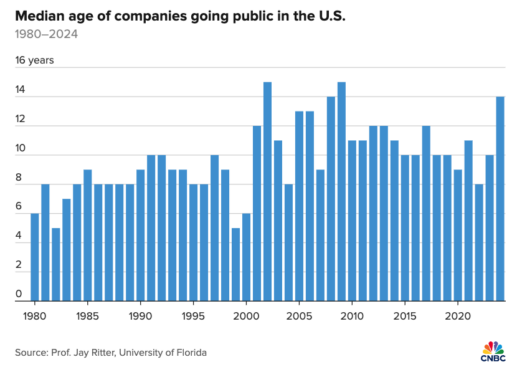
Staying private generally means a company continues to raise money through successive private financing rounds rather than turning to public markets for capital. In many cases, this allows a business to fund its operations and growth without the obligations that can come with being publicly traded. The result is that companies may now reach considerable scale, and in some cases valued at over $100 billion, while remaining privately held.
Why Companies Are Delaying Going Public
There are a few reasons why companies might be delaying their public debuts and opting to stay private longer instead.
Availability of Private Capital
One commonly cited factor is the increased availability of private capital. Global private-equity assets under management have grown by more than 15% annually over the past decade to over $12 trillion in 2025 and are projected to reach roughly $25 trillion over the next decade. North American venture capital assets are likewise expected to rise from $1.36 trillion at the start of 2025 to $1.8 trillion by 2029, as private fundraising and secondary marketplaces reduce companies’ reliance on IPOs for capital and employee liquidity.[ii]
Public Reporting Costs
The costs and obligations of being a public company can also play a role. Public companies are generally subject to extensive reporting requirements, regulatory scrutiny, and the pressures of quarterly earnings expectations. Some companies may prefer to avoid this short-term performance cycle, which can sometimes conflict with longer-term strategic priorities.
Founder Control
Finally, staying private can offer founders and management more control. Public companies typically answer to a broad base of shareholders who may hold differing views on a company’s direction. Remaining private may give leadership greater flexibility to pursue its own vision without that pressure.
What It Means for Investors
Perhaps one of the most significant implications of this trend is where company growth occurs. Historically, much of a company’s high-growth phase happened after it went public, giving public-market investors access to that period. As companies stay private longer, a larger share of that growth may now take place before a public listing, out of reach for many traditional public-market participants.
This can create both potential opportunities and limitations. For investors with access to private markets, a longer private window may mean more time to participate in a company’s development before an exit. At the same time, private investments are generally illiquid, can involve longer hold periods, and may come with less publicly available information than public companies. Investors may want to carefully weigh these tradeoffs.
How Investors May Approach a Longer Private Window
A longer private phase can mean that the timeline to a liquidity event, such as a startup exit, may extend further into the future. For late-stage private investments, an anticipated exit time horizon of approximately five to seven years is sometimes used as a general guideline, though actual timing can vary and is never guaranteed. Given this, investors may want to allocate a smaller portion of their overall portfolio to private investments, sized so that an extended holding period doesn’t compromise near-term liquidity needs.
Investors may also want to consider the benefits of diversification in light of longer holding periods. A longer holding period can give investors opportunities to diversify their investments across market cycles and a company’s growth stages, potentially smoothing exposure to any single point in a company’s development or a particular private market environment.
Final Thoughts
Many companies are choosing to stay private longer, supported by greater access to private capital and a desire to avoid some of the obligations of being publicly traded. For investors, this trend may mean that a larger share of company growth now occurs during the private stage, which can present both potential opportunities and meaningful limitations. Understanding longer hold periods, liquidity considerations, and the risks involved can help investors form their own view of what a longer private window means for them.
Are you ready to invest in startups? Sign up for a MicroVentures account to start investing!
Want to learn more about investing in startups? Check out the following MicroVentures blogs to learn more:
- How the Secondary Market Became a $106 Billion Opportunity in Startup Investing
- What to Look for in Investment Updates
- Understanding Startup Revenue Models
- From Insight to Investment: Early-Stage Due Diligence
- The Megaround Era: What Larger Funding Rounds May Mean for Private Market Investors
Sources
Important disclosure
The information presented here is for general informational purposes only and is not intended to be, nor should it be construed or used as, comprehensive offering documentation for any security, investment, tax or legal advice, a recommendation, or an offer to sell, or a solicitation of an offer to buy, an interest, directly or indirectly, in any company. Investing in both early-stage and later-stage companies carries a high degree of risk. A loss of an investor’s entire investment is possible, and no profit may be realized. Investors should be aware that these types of investments are illiquid and should anticipate holding until an exit occurs.