
The private market has long run on a simple liquidity model. Investors back a company, wait for an initial public offering (IPO) or acquisition, and collect their returns. That model is evolving. A market that was once used only by institutional insiders has grown into a liquidity channel in venture capital (VC), with PitchBook estimating the total value traded through U.S. venture secondaries in 2025 at $106.3 billion.[1] For private market investors, understanding how the venture secondary market works and why it’s growing so rapidly may be key to navigating the next decade of startup investing.
What Is the Secondary Market?
In private markets, a secondary transaction is any sale of an existing stake in a private company or fund, rather than a direct investment in a new round. Some of the most common types include the following:
- LP-led secondaries occur when an existing investor sells their stake in a private fund or company to another buyer, typically because they need liquidity before a traditional exit event.
- GP-led secondaries happen when a fund manager moves one or more portfolio companies into a new vehicle, called a continuation fund, allowing investors who want liquidity to cash out while others roll their investment forward.
- Company-facilitated secondaries involve a private company organizing a formal tender offer or structured liquidity program, allowing employees and early investors to sell shares directly to institutional buyers or new investors. Companies like SpaceX and OpenAI have used this approach to provide liquidity to stakeholders without going public. Tender offers are becoming standard practice among leading startups, with the average time between tenders decreasing from 899 days in 2022 to just 132 days in 2025.[2]
While these are among the most prevalent structures, each transaction ultimately serves the same fundamental need of creating liquidity in a market that was historically illiquid. What has changed in recent years is the scale at which that need is being met.
Why the Market Is Increasing
The venture secondary market’s growth is not happening in a vacuum. It is a direct response to two structural forces that have been building for years.
Exit Backlog
The first is the exit backlog. Companies are staying private significantly longer than previously. The median age of companies going public has risen to 13 years since founding, up from a median of 10 years in 2018.[3] At the end of 2025, nearly half of unicorns had their first VC round in 2016 or earlier, meaning early employees and investors in some of venture’s most valuable companies have been waiting over a decade for a liquidity event.[4] With the IPO window historically unpredictable and M&A activity uneven in recent years, investors who backed companies years ago are increasingly turning to the secondary market to access returns rather than waiting indefinitely.
Growing Acceptance
The second force is the growing acceptance of secondaries as a mainstream portfolio management tool. What was once viewed as a last resort for distressed sellers has become a core part of how VC assets are managed. PitchBook notes that venture secondaries are now structural, not cyclical, having proven their relevance both during the pandemic-era increase and through the liquidity drought that followed. Major financial institutions have taken notice. In 2025, Goldman Sachs acquired Industry Ventures, Morgan Stanley acquired EquityZen, and Charles Schwab acquired Forge Global, each making deliberate moves to expand retail and institutional access to the venture secondary market.[5]
The Numbers Behind the Growth
The scale of the market’s expansion is striking. PitchBook estimates the total U.S. venture secondary market reached $106.3 billion in 2025, comprising $91.7 billion in direct secondaries and $14.6 billion in GP-led transactions.[6] By Q1 2026, the annualized value had climbed further to $112.2 billion, exceeding public listings as a source of VC exit value for the first time.[7]
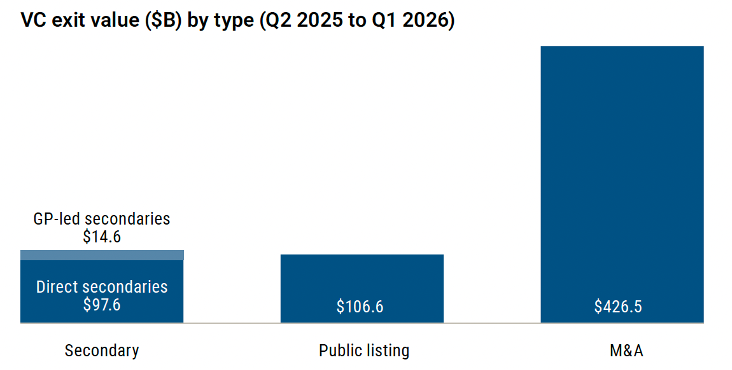
Dedicated dry powder in U.S. venture secondary funds reached $11.8 billion as of mid-2025, up 2.8x since 2022, reflecting growing institutional conviction in the market.[8] The buyer base is also broadening, with large new entrants launching dedicated venture secondary funds and major banks building out private market capabilities to serve wealth management clients seeking exposure to late-stage private companies.
It is worth noting that the venture secondary market remains heavily concentrated. According to Caplight data, 75% of special purpose vehicles (SPVs) with carry are concentrated in just five names, SpaceX, Anthropic, OpenAI, xAI, and Anduril, reflecting how much of the market’s growth has been driven by a narrow group of generational companies. As these companies prepare for potential IPOs in 2026, with SpaceX leading the way in its record-breaking June 2026 public offering,[9] the market is expected to see some short-term contraction in headline volume before the next tier of secondary names fills the gap.[10]
What This Means for Private Market Investors
For investors in private companies and funds, the venture secondary market matters in two distinct ways – as a source of liquidity and as a potential entry point.
Liquidity
On the liquidity side, the growth of the secondary market means that early investors in private companies have more options than they once did. Rather than waiting years for an IPO or acquisition, investors may be able to sell their stakes through secondary transactions. Platforms that facilitate secondary trading for accredited investors have become an increasingly important part of this ecosystem, giving a broader set of investors access to a market that was once dominated by large institutions.
Entry
On the entry side, secondary transactions can offer investors a way to gain exposure to later-stage private companies at a potentially lower risk profile than early-stage investing. Because the underlying companies are more mature, their business models are better understood and their track records are more visible. However, secondary pricing can reflect significant discounts or premiums depending on the company and market conditions. According to Forge data, secondary transactions in companies that last raised in 2021 trade at a median discount of 60% to their last valuation, while more recent vintages trade much closer to par.[11]
Secondary Market Risks
Risks remain, as they do with any investment strategy. The market is still relatively opaque, with limited standardization across transaction types and platforms. Secondary market pricing can fluctuate with public market conditions, and concentration in a handful of elite names means that a wave of mega-IPOs could temporarily reduce available deal flow. Understanding the cap table and the terms of any secondary transaction remains essential before committing capital.
Final Thoughts
The venture secondary market is no longer a niche corner of private finance. What began as a last-resort liquidity mechanism has evolved into embedded infrastructure, a market that is now central to how capital is raised, allocated, and returned across the venture ecosystem. For investors willing to understand how it works, the venture secondary market may represent one of the most significant structural opportunities in private markets today, whether as a path to liquidity, an entry point into late-stage companies, or simply a sign of how much the private investing landscape has matured.
Are you ready to invest in startups? Sign up for a MicroVentures account to start investing!
Want to learn more about investing in startups? Check out the following MicroVentures blogs to learn more:
- Secondaries and Tenders: Private Market Liquidity
- What Happens When a Startup is Acquired Before an IPO?
- The Rise of Agentic AI: What Investors Need to Know
- The Psychology of Investing: Navigating Investment Bias
- What’s It Worth? Navigating Inflated Startup Valuations
[1] PitchBook 2025 Annual US VC Secondary Market Watch Report, February 2026
[2] PitchBook 2025 Annual US VC Secondary Market Watch Report, February 2026
Sources
[4] PitchBook 2025 Annual US VC Secondary Market Watch Report, February 2026
[5] PitchBook 2025 Annual US VC Secondary Market Watch Report, February 2026
[6] PitchBook 2025 Annual US VC Secondary Market Watch Report, February 2026
[7] PitchBook Q1 2026 US VC Secondary Market Watch Report, May 2026
[8] PitchBook 2025 Annual US VC Secondary Market Watch Report, February 2026
[10] PitchBook Q1 2026 US VC Secondary Market Watch Report, May 2026
[11] PitchBook Q1 2026 US VC Secondary Market Watch Report, May 2026
Important disclosure
The information presented here is for general informational purposes only and is not intended to be, nor should it be construed or used as, comprehensive offering documentation for any security, investment, tax or legal advice, a recommendation, or an offer to sell, or a solicitation of an offer to buy, an interest, directly or indirectly, in any company. Investing in both early-stage and later-stage companies carries a high degree of risk. A loss of an investor’s entire investment is possible, and no profit may be realized. Investors should be aware that these types of investments are illiquid and should anticipate holding until an exit occurs.