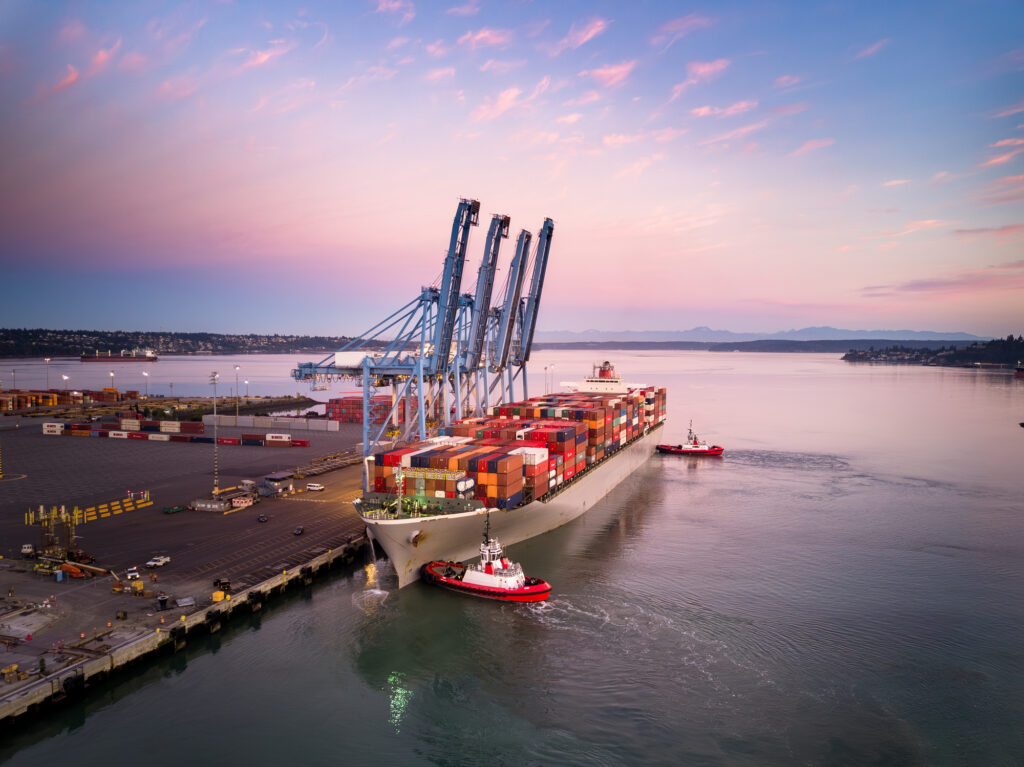
As global commerce becomes more and more interconnected, the supply chain and logistics technology industry is helping enable the efficient movement of products from factories to front porches. While e-commerce and global trade have become more common, facilitated by internet access, the sector has grown in recent years. However, U.S. tariffs have unveiled new challenges for the industry. In this blog, learn more about the growth of supply chain and logistics tech, key players in the industry, and some trends to keep an eye on in 2026.
The Growth of Supply Chain and Logistics Tech
Current State of the Industry
The supply chain and logistics tech industry appears to be at an interesting crossroads. The industry grew from being valued at $26.25 billion in 2024 to $29.34 billion in 2025. This value is expected to more than double to $72.82 billion by 2034, anticipating a 10.4% compound annual growth rate.[1] However, venture capital funding to the sector has experienced a downturn from 2021 to 2024, recording less than $6 billion in funding across 741 funding deals, according to Crunchbase. This marks a sharp contrast from the $28 billion supply chain and logistics tech startups raised in 2021 across 1,554 deals.[2]
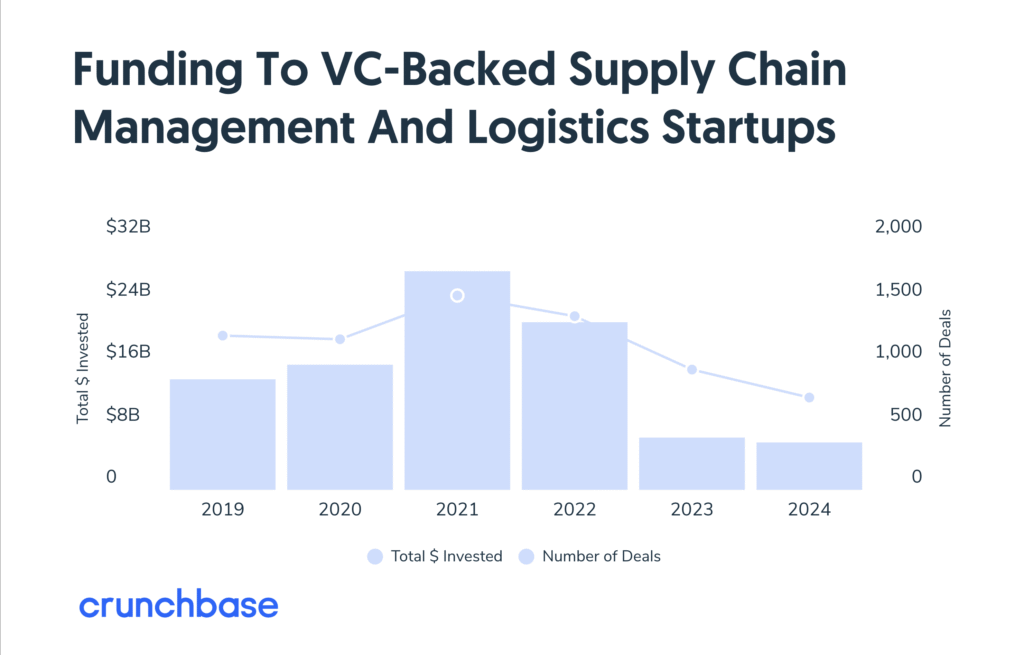
With the juxtaposition of increasing market demand paired with decreasing venture funding to the sector, we appear to be at an interesting crossroads. PitchBook reported venture funding has begun a potential rebound, with $3 billion in funding recorded in Q3 2025, a 26.1% increase quarter-over-quarter and 28% increase year-over-year.[3] Will venture funding pick up in 2026? What could be next for this growing industry?
Challenges Facing the Industry
Several headwinds have been creating unique challenges for the industry going into 2026.
Tariffs
The introduction of new global tariffs has proved challenging for the industry. In a survey of 100 companies conducted by McKinsey, 82% of respondents said their supply chains have been affected by new tariffs, 39% have seen increases in supplier and material costs, and 30% reported decreases in customer demand for their products. Consumer goods appear to have taken the brunt of the impact, and the overall increase in cost for manufacturers has poised the question of edging in on margins or passing costs onto customers.
Fragmented Visibility
Another challenge that has proved difficult for the industry is fragmented visibility across the various touchpoints of the supply chain. Data silos across transportation, warehousing, enterprise systems, and last-mile delivery make transparency challenging. End-to-end visibility from factories to front porches can be difficult to achieve, making communication challenging, leaving customers in the dark, and allowing various shipments to fall through the cracks, losing packages and costing companies additional expenses to replace the items.
Opportunities for the Industry
Despite the challenges to the industry, innovative companies are prioritizing resilience, flexibility, and intelligence. With many startups being formed and becoming well positioned to tackle these challenges, the following are some of the opportunities startups may want to use for an advantage.
AI and Advanced Analytics
Artificial intelligence has many use cases, and its ability to optimize utilization, predict disruptions, and dynamically reroute shipments may help supply chain and logistics companies stay ahead of challenges. If startups are able to automate communication, demand planning, and forecasting, they have the potential to help customers stay informed and minimize costly mistakes for companies like overstocking or losing shipments.
Cost Optimization and Network Resilience Tools
With cost sensitivity surrounding the new set of tariffs, one can reasonably expect that demand for technologies that provide deeper visibility into total costs will increase as customers change purchasing decisions and businesses desire to protect margins. One opportunity could be platforms for a dynamic transportation management solution that optimizes method and route depending on market conditions and rates, flexing between ocean, air, freight, or trucking methods as opportunities arise. Options like less-than-truckload (LTL) or partial truckload (PTL) may be used more to allow companies to split the costs of shipping cargo.
Enhanced End-to-End Visibility and Orchestration
The lack of visibility in end-to-end shipping solutions is a core challenge for the industry, which can lead to higher costs and longer lead times due to fragmented communication and the inability to see if items have gotten lost in transit. An opportunity exists for a company that can integrate data across transportation, warehousing, and enterprise systems in order to provide a single source of truth and visibility into each step of the process.
Key Players
The following are some MicroVentures portfolio companies that are innovating within the supply chain and logistics tech industry.
Motive
Motive provides an integrated platform for supply chain management that combines hardware with AI-driven software with a goal of improving fleet management, driver safety, and operational efficiency. By offering real-time visibility into the vehicle location, fuel usage, and driver behavior, Motive aims to help trucking companies reduce costs and enhance compliance.

Flexport
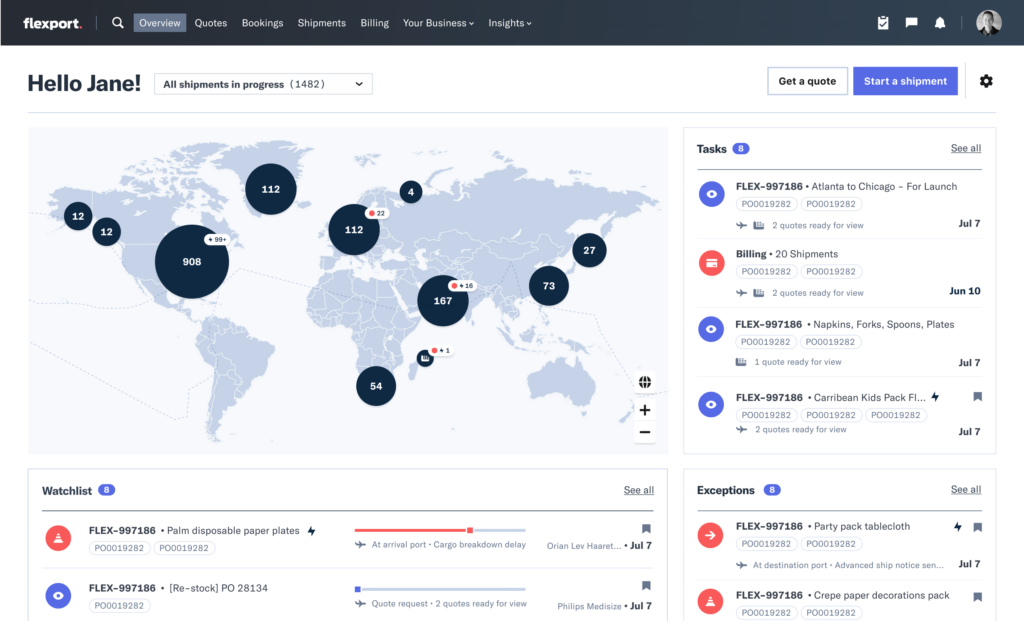
Flexport operates a digital freight platform designed to simplify global trade. By centralizing shipment data, documentation, and logistics services, Flexport aims to provide companies with enhanced transparency and supply chain control across ocean, air, and land shipments.
Stord
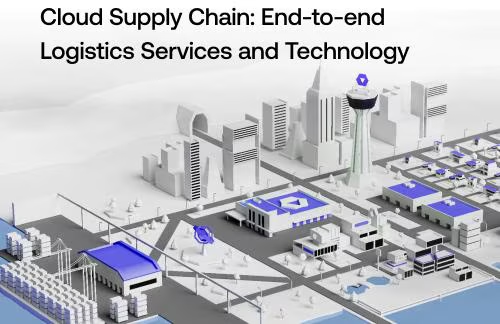
Stord offers a cloud-based logistics platform engineered to integrate warehousing, transportation, and inventory management into a single interface. By leveraging a distributed network of fulfillment centers, Stord aims to help brands scale their physical logistics with great agility and cost efficiency.
Cart.com
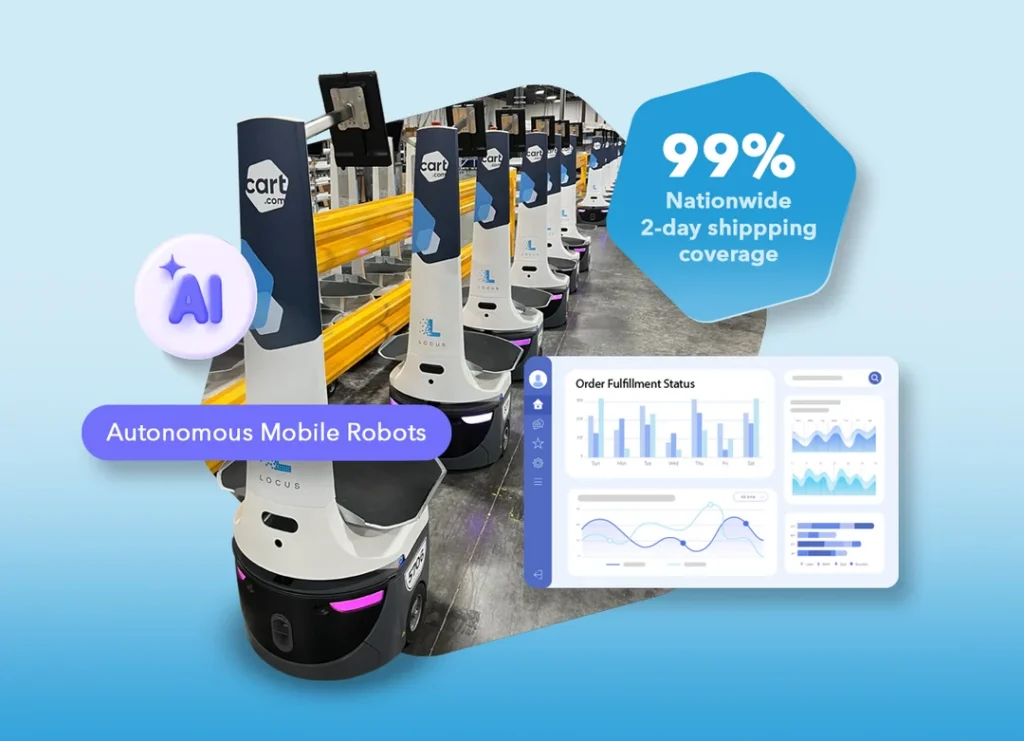
Cart.com provides an end-to-end e-commerce infrastructure spanning fulfillment, software, and digital market services. Its solutions are designed to help online merchants optimize their supply chains, improve delivery performance, and manage growth complexity.
Loadsmart
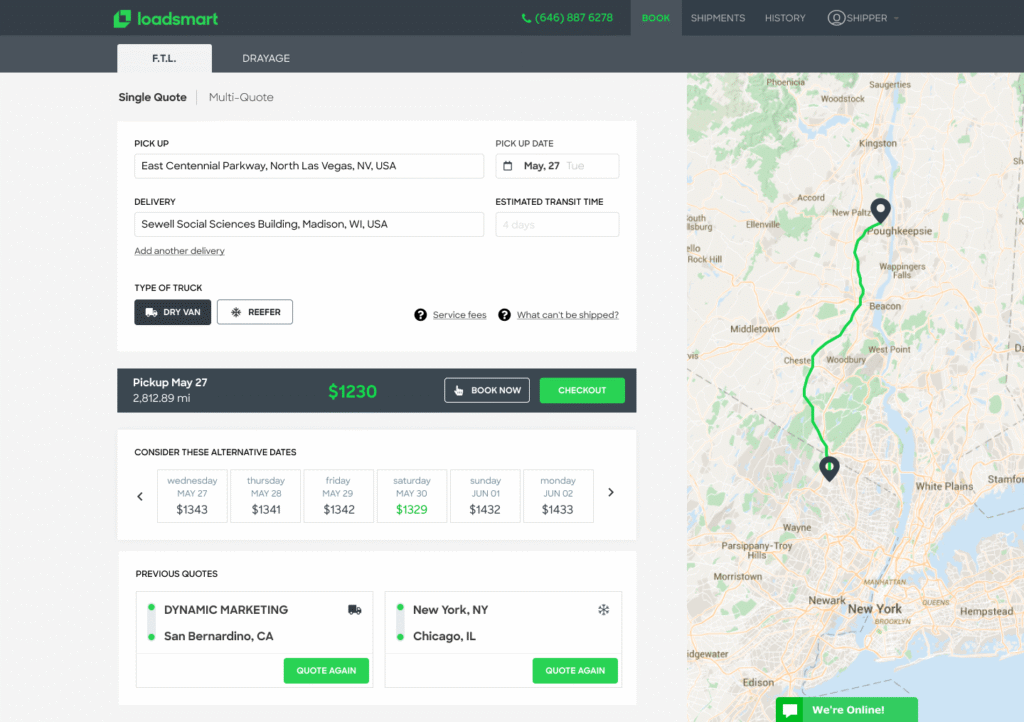
Loadsmart utilizes AI and automation to streamline freight booking and pricings. Its platform offers real-rate pricing, digital tendering, and shipment tracking, aiming to reduce manual processes and improve load matching efficiency for shippers and carriers.
Final Thoughts
The supply chain and logistics tech industry has been undergoing a significant transformation since COVID-19 increased the demand for e-commerce. While challenges still face the industry like tariffs and visibility constraints, there are many opportunities for startups. There are already innovative companies aiming to bridge the gaps to get products from factories to front doors, and it will be interesting to see how these companies evolve, what new challengers emerge, and how the industry as a whole is able to tackle challenges and take advantage of opportunities.
Are you ready to invest in supply chain and logistics tech startups? Sign up for a MicroVentures account to start investing!
Want to learn more about industries to keep an eye on? Check out the following MicroVentures blogs to learn more:
- Going Digital: The Rise of HealthTech
- Investing in the Future: The Rise of GreenTech
- Disruption in Motion: Analyzing Quantum Computing
- Navigating the Digital World: The Growth of Cybersecurity
- Beyond the Battlefield: Defense Technology
[1] https://www.fortunebusinessinsights.com/supply-chain-management-market-102977
[2] https://news.crunchbase.com/transportation/supply-chain-logistics-funding-falls/
[3] https://pitchbook.com/news/reports/q3-2025-supply-chain-tech-vc-trends
*****
The information presented here is for general informational purposes only and is not intended to be, nor should it be construed or used as, comprehensive offering documentation for any security, investment, tax or legal advice, a recommendation, or an offer to sell, or a solicitation of an offer to buy, an interest, directly or indirectly, in any company. Investing in both early-stage and later-stage companies carries a high degree of risk. A loss of an investor’s entire investment is possible, and no profit may be realized. Investors should be aware that these types of investments are illiquid and should anticipate holding until an exit occurs.
