
Cash, Stock, or Earnout? What Investors Should Know as M&A Activity Increases in 2026
When a privately held company agrees to be acquired, investors in that company often focus on one number: the headline purchase price. However, the form that payment takes can shape when proceeds arrive, how much risk remains after the deal closes, and whether the final amount ends up matching the announced one. In this blog, learn more about the different ways acquisitions are paid for, what the 2026 data shows about deal structure, and what investors may want to consider as mergers and acquisitions (M&A) activity accelerates.
2026 Dealmaking by the Numbers
Deal activity has rebounded in 2026. U.S. M&A volume reached a record $1.9 trillion in the first half of 2026, driven by a 3.4x increase in transactions valued above $10 billion, according to Wells Fargo’s 2Q 2026 M&A Market Pulse. Those megadeals accounted for 56% of total first-half volume, compared with 31% a year earlier.[i]
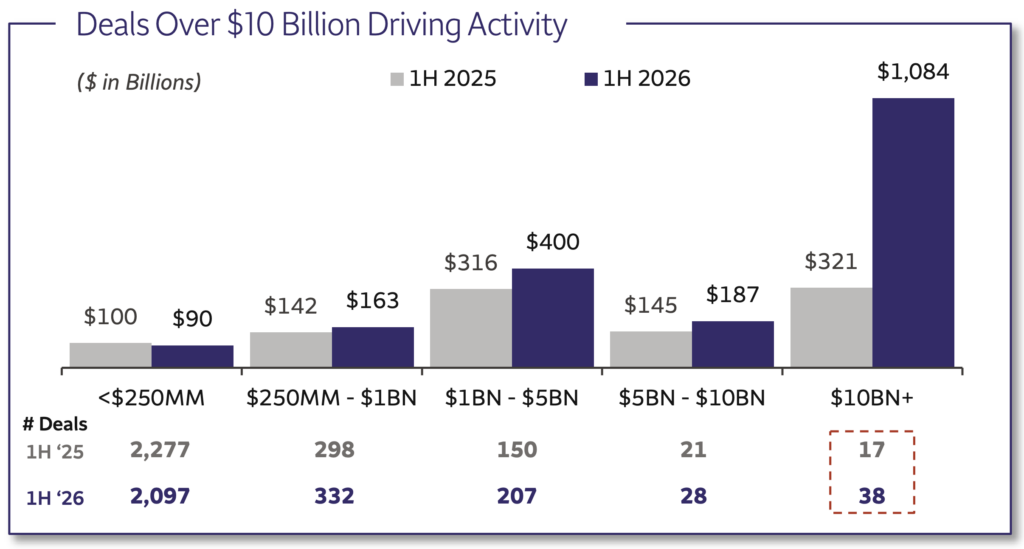
Activity has not been evenly distributed. Deal counts in the smallest size range, below $250 million, declined year-over-year even as overall value climbed. PwC has described the current environment as a K-shaped market, in which well-capitalized buyers pursue scale while many mid-market dealmakers remain constrained by valuation gaps, financing costs, and geopolitical uncertainty.[ii]
Three Ways an Acquisition Can Be Paid For
Less discussed than the volume figures is a shift in how buyers are paying. All-cash transactions made up 81% of U.S. announced deal volume in 2022. By the first half of 2026, that share had fallen to 57%, with deals using stock or a cash and stock mix rising to 43% of volume.
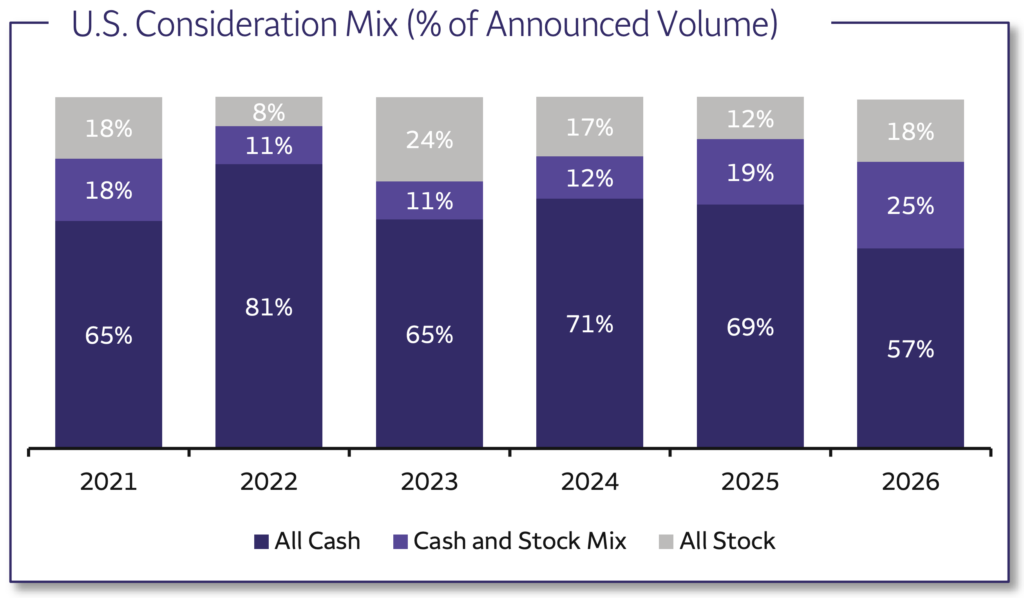
Wells Fargo attributed part of the shift to rising equity markets, which can make a buyer’s shares a more attractive currency, and to acquirers looking to preserve balance sheet flexibility on larger deals. What a buyer offers is generally referred to as consideration, and it typically falls into a few broad categories. Most deals combine more than one.
Cash
Cash is generally the most straightforward outcome for a selling company’s shareholders. The amount is typically fixed at closing, and once proceeds are distributed, the investor’s exposure to the business usually ends. Cash outcomes can still involve delays, since portions of the purchase price are often held back in escrow to cover potential post-closing claims. A cash sale may also create a taxable event in the year it closes, which investors may want to discuss with a tax professional.
Stock
In a stock deal, shareholders receive shares in the acquiring company rather than cash. This can be appealing when the buyer is viewed as a strong long-term business, because it allows investors to participate in whatever value the combined company goes on to create. It also changes the nature of the risk. The value received can move between announcement and closing, and if the buyer is publicly traded, shares may be subject to lockup or registration requirements that delay when they can be sold. If the buyer is privately held, an investor may effectively be exchanging one illiquid position for another.
Earnouts and Rollover Equity
An earnout defers part of the purchase price and pays it only if the business hits agreed targets after closing, such as revenue thresholds or product milestones. They serve two purposes. One is bridging a valuation gap, letting a buyer avoid paying today for growth it has not seen while the seller keeps a path to the price it wanted. The other is keeping management motivated to run the business rather than collect a check and move on. A buyer might pay $60 million at closing and up to $20 million more if a revenue target is met within two years. Miss the target, and the effective price ends up below the announced one.
Rollover equity works differently. Instead of being cashed out, some owners convert part of their stake into ownership under the new owner. This is most common with private equity buyers and usually applies to founders and management rather than all shareholders. It reduces the cash a buyer needs at closing and offers management what is sometimes called a second bite at the apple if the business sells again later. A founder holding 15% might sell most of that position for cash and roll the rest into a smaller stake going forward.
What This May Mean for Investors
Two offers carrying the same headline number can pay out very differently. Investors may want to look past the announced price and consider how much of it is payable in cash at closing, how much is contingent on future events, and over what period.
Earnouts appeared in 24% of private-target deals in the SRS Acquiom 2026 M&A Deal Terms Study, up from 22% in 2024 and above a historical average of roughly 20%. The median earnout potential also climbed to 34% of the closing payment, and roughly 38% of earnouts were structured to run one to two years. For an investor, that can mean a meaningful share of an exit arriving well after a deal is announced, if performance conditions are met.[iii]
Timing can matter for late-stage positions, where anticipated holding periods are often already measured in years. An earnout period, escrow release schedule, or stock lockup may extend that timeline further. Investors conducting due diligence on a position may also want to consider how a company’s likely acquirers tend to structure deals, since a buyer with a strong balance sheet may be more able to pay cash than one preserving capital for other priorities.
Final Thoughts
A rising M&A market can create more opportunities for privately held companies to be acquired, but the announced price is only part of the picture. Cash, stock, and earnout structures each carry different implications for timing, certainty, and the risk an investor continues to hold after a deal closes. As deal structures continue to shift, understanding how an acquisition is being paid for may be as important for investors as understanding what it is worth.
Are you ready to invest in startups? Sign up for a MicroVentures account to start investing!
Want to learn more about investing in startups? Check out the following MicroVentures blogs to learn more:
- What Happens When a Startup is Acquired Before an IPO?
- Navigating Startup Exits
- AI Acquihires: Why Big Tech May Buy Talent Instead of Companies
- Navigating Exit Strategies: What an IPO, M&A, and More Mean for Investors
- The Megaround Era: What Larger Funding Rounds May Mean for Private Market Investors
Sources
- [i]wellsfargomedia.com — https://www.wellsfargomedia.com/wholesale/PDS/Wells-Fargo-MA-Market-Pulse-2Q-2026.pdf
- [ii]pwc.com — https://www.pwc.com/gx/en/services/deals/trends.html
- [iii]fasken.com — https://www.fasken.com/en/knowledge/2026/05/private-ma-deal-trends-to-watch-key-takeaways-from-srs-acquioms-2026-study
Important disclosure
The information presented here is for general informational purposes only and is not intended to be, nor should it be construed or used as, comprehensive offering documentation for any security, investment, tax or legal advice, a recommendation, or an offer to sell, or a solicitation of an offer to buy, an interest, directly or indirectly, in any company. Investing in both early-stage and later-stage companies carries a high degree of risk. A loss of an investor’s entire investment is possible, and no profit may be realized. Investors should be aware that these types of investments are illiquid and should anticipate holding until an exit occurs.