Understanding the SpaceX IPO
For more than two decades, SpaceX has been one of the most closely watched private companies in the world, and in May 2026, the company filed its S-1 with the U.S. Securities and Exchange Commission (SEC), formally opening the door to a public listing. The filing covers far more than launches and reusable rockets, with detailed disclosures on satellite broadband, AI infrastructure, and a string of recent strategic deals. The company plans to list on the Nasdaq Stock Market and Nasdaq Texas under the ticker symbol “SPCX.” For context, an S-1 is the registration statement a company files with the SEC to publicly disclose its business, financials, and risks ahead of an IPO. SpaceX is a MicroVentures portfolio company. In this blog, learn more about what SpaceX’s S-1 reveals and what investors may want to consider.
What Is SpaceX?
Rockets are still where SpaceX started, but the S-1 makes it clear they are no longer the whole story. Founded in 2002, the Starbase, Texas-based company describes its mission as making life multiplanetary, and now pursues that goal as a vertically integrated business across three segments:
- Space: Launch services, including Falcon, Dragon, and the next-generation Starship vehicle, with the U.S. government as a primary customer.
- Connectivity: Starlink satellite broadband and mobile network, the company’s largest revenue contributor.
- AI: AI compute infrastructure, Grok, and X, added through the acquisition of SpaceXAI (formerly xAI) in February 2026.
The S-1 describes a strategy in which Falcon and Starship enable Starlink’s deployment, Starlink generates the cash flow to fund the company’s longer-term ambitions, and the AI segment builds on top of both. Few companies can match that combination. SpaceX positions it as a competitive moat, and the foundation for ambitions like orbital AI compute that no single-segment business could pursue alone.
What The Numbers Actually Say
The numbers show a company with major scale, strong operating momentum in Starlink, and enormous investment needs.
For the full year 2025, SpaceX reported:
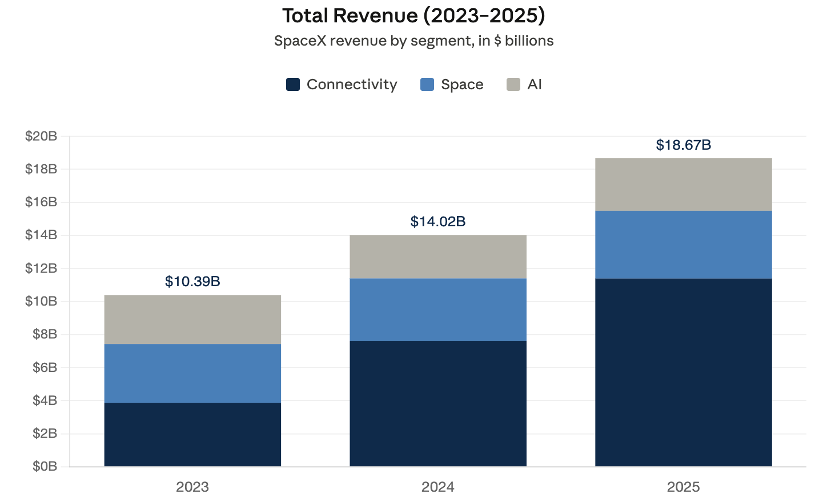
- Revenue: $18.67 billion, up 33.2% from $14.02 billion in 2024
- Loss from operations: $2.6 billion
- Adjusted EBITDA: $6.6 billion
For Q1 2026, SpaceX reported:
- Revenue: $4.7 billion
- Loss from operations: $1.9 billion
- Adjusted EBITDA: $1.1 billion
The simple takeaway: SpaceX is generating significant revenue and meaningful Adjusted EBITDA, but it is still losing money on a GAAP basis because of the scale of its reinvestment. Investors evaluating the company’s spending pattern may want to consider the same factors discussed in our evaluating use of funds blog, where understanding how a company allocates capital across competing priorities can be particularly relevant.
The Starlink Business Makes the IPO Work
The Connectivity segment, driven almost entirely by Starlink, is what gives SpaceX the financial profile of an IPO-ready company. According to the filing:
- 2025 revenue: $11.39 billion, up 49.8% year-over-year
- 2025 income from operations: $4.42 billion
- 2025 Segment Adjusted EBITDA: $7.17 billion
- Subscribers: ~10.3 million Starlink subscribers across 164 countries, territories, and other markets as of March 31, 2026
- Satellite-to-mobile: ~ 650 V1 Mobile satellites serving ~7.4 million monthly unique devices across approximately 30 countries
- Constellation Scale: ~9,600 Starlink satellites in Low-Earth Orbit as of March 2026, approximately 75% of all active maneuverable satellites in orbit per the filing
Connectivity is the only segment that is meaningfully profitable on a GAAP basis, and it’s also the segment with the clearest unit economics. It provides investors a tangible business to anchor on as the rest of the company scales.
The Space Business is Being Built for the Future
The Space segment is SpaceX’s original business, and where much of its future investment is still going, particularly toward Starship. Key highlights include:
- 2025 revenue: $4.09 billion
- 2025 loss from operations: $657 million
- 2025 Segment Adjusted EBITDA: $653 million
- Customers: Commercial, civil, international, and government customers, with SpaceX as the primary launch provider for the U.S. government
- Launch track record: more than 80% of mass to orbit globally each year since 2023, with an over 99% mission success rate across Falcon rockets
Much of the segment’s current investment is directed toward Starship, which is central to the company’s broader strategy. Without Starship operating reliably at scale, several of SpaceX’s longer-term ambitions, including next-generation Starlink V3 satellites and orbital AI compute, become much harder to execute.
AI is the Biggest New Bet
The AI segment is the newest and most capital-intensive. The disclosed figures include:
- 2025 revenue: $3.20 billion
- 2025 loss from operations: $6.36 billion
- 2025 Segment Adjusted EBITDA: ($1.24) billion
- Infrastructure: COLOSSUS and COLOSSUS II AI compute facilities, collectively providing ~1.0 gigawatt of compute power
- Reach: ~550 million monthly active users (MAUs) across Grok and X, including ~117 million Grok MAUs
The AI segment is where most of SpaceX’s recent capital is going, and where its most ambitious long-term bets sit. In the near term, that means scaling COLOSSUS, expanding Grok, and building the infrastructure to compete with the world’s largest cloud providers.
Beyond that, SpaceX wants to deploy AI compute in orbit, powered by continuous solar energy and launched cheaply via Starship, effectively turning space into the next frontier for data center infrastructure. It is a category no ground-based competitor could replicate, and whether SpaceX can pull it off is one of the biggest open questions in the entire filing.
Market Opportunity
SpaceX estimates it total addressable market (TAM) at ~$28.5 trillion, broken down as follows:
- Space: ~$370 billion
- Connectivity: ~$1.6 trillion
- AI: ~$26.5 trillion
The AI portion dominates the TAM, which shows how much of the long-term valuation argument depends on SpaceX becoming a major AI infrastructure company.
It is important to treat this number as an ambition, not a forecast.
The S-1 itself warns that market opportunity estimates may prove inaccurate. That is especially relevant here because many of the largest opportunities depend on technologies and markets that are still early or unproven, including orbital AI compute, lunar infrastructure, Mars transport, and large-scale space industrialization.
Recent Developments
The S-1 discloses several recent transactions that suggest where the company is investing its strategic attention. Three stand out.
Anthropic Becomes a Major Compute Customer
In May 2026, Anthropic agreed to pay SpaceX $1.25 billion per month through May 2029, an aggregate of roughly $40 billion, for compute capacity across COLOSSUS and COLOSSUS II. Either party may terminate on 90 days’ notice.
Beyond the headline dollars, the deal signals that SpaceX’s compute is competitive enough to attract a frontier AI lab as a customer. If SpaceX can sign others on similar terms, the AI segment’s revenue base could shift toward a more diversified, contracted profile rather than relying solely on Grok and X.
Cursor Becomes Both Customer and Potential Acquisition
SpaceX signed a compute and option agreement with Anysphere, the company behind Cursor. The compute portion provides GPU capacity to Cursor; the option gives SpaceX the right, but not the obligation, to acquire Cursor at a $60.0 billion implied equity value. The filing also discloses a $1.5 billion termination fee and an $8.5 billion deferred services fee under certain circumstances.
The Cursor arrangement is notable because it’s both a customer relationship and a potential acquisition path, which could signal that SpaceX is positioning its AI segment to capture not just compute revenue but also AI application-layer companies.
Terafab Sets a One-Terawatt Chip Ambition
In March 2026, SpaceX announced a framework with Tesla for an initiative called Terafab, with Intel joining the following month. The S-1 describes Terafab as a chip manufacturing effort with a long-term goal of producing one terawatt of compute hardware each year.
Terafab is the most speculative of the three. If executed, it could reduce SpaceX’s reliance on third-party chip suppliers over time, but the filing’s hedged language suggests the path from framework to commercial production is far from settled.
The Biggest Risks
The S-1 contains a long list of risk factors, but several stand out for investors.
Starship execution risk is central. Many future initiatives, including Starlink V3, satellite-to-mobile, and orbital AI compute, depend on Starship becoming fully reusable at scale.
AI infrastructure is substantial. SpaceX is spending heavily on compute, power, and AI processors in a fast-moving market where demand or competition could shift quickly.
Regulatory risk remains significant. SpaceX depends on FAA, FCC, and international approvals, with active inquiries from the Irish DPC, FTC, Ofcom, ICO, and other regulators.
Capital intensity is unavoidable. Despite $6.58 billion of Adjusted EBITDA in 2025, the company’s ambitions require massive ongoing investment, and total principal indebtedness stood at $29.13 billion as of March 31, 2026.
Governance risk is real. Public shareholders will have limited voting power, and Elon Musk’s control will shape the company’s strategic direction for the foreseeable future.
Capital Structure
Upon completion of the SpaceX IPO, the company plans to have two classes of common stock outstanding:
- Class A: Offered in the IPO; one vote per share
- Class B: Held by insiders, including Elon Musk; 10 votes per share
Musk, the company’s founder, CEO, CTO, and Chairman, is expected to hold a majority of the voting power following the offering. As a result, SpaceX will be a “controlled company” under Nasdaq corporate governance rules and intends to rely on exemptions from certain governance requirements.
According to public reporting on the offering, SpaceX is expected to raise approximately $75 billion at an implied valuation of approximately $1.75 trillion, though the share price range and total shares offered would typically appear in a later amended filing. For more on what to consider after a company goes public, check out What to Look for in Investment Updates.
What to Watch Next
As the IPO nears and trading begins, a few specific markers may be worth tracking:
Pricing range, valuation, and offering size: Still blank in the preliminary S-1, these figures will determine how much capital SpaceX is raising and how much dilution public investors will absorb.
Starship development milestones: Successful test flights, reusability progress, and orbital readiness will likely move the broader business narrative.
Starlink subscriber and ARPU trends: Connectivity is the segment carrying the IPO’s profitability story; any deceleration would be material.
Additional AI compute customers: Whether the Anthropic deal proves to be a template for similar agreements with other AI labs.
The Cursor option: Whether SpaceX exercises the option, lets it lapse, or renegotiates the terms.
Regulatory developments: FAA launch cadence approvals, FCC spectrum decisions, and ongoing AI-related inquiries across multiple jurisdictions.
Musk’s post-IPO voting control: The dual-class structure gives Elon Musk a majority of the voting power after the offering, meaning strategic decisions will largely reflect his direction rather than that of public shareholders.
Final Thoughts
The SpaceX S-1 paints a picture of a company with three different business engines: a profitable satellite broadband network, a launch business still building toward its next chapter, and a recently acquired AI segment that is the company’s biggest current bet. The financial story is one of meaningful revenue growth alongside meaningful losses and heavy investment, with a Connectivity business that is doing much of the work to keep the overall picture credible.
For investors, the S-1 is a starting point, not a verdict. The strategic deals with Anthropic, Cursor, and Terafab signal where the company is leaning, but the path from filing to public-market performance will depend on execution against Starship, the durability of Starlink’s growth, and how the AI segment evolves over the next several years. Beyond the markers above, the S-1’s risk factors, financial statements, and capital structure sections are worth a closer read for anyone building a view on the offering.
Are you ready to invest in startups? Sign up for a MicroVentures account to start investing!
Want to learn more about investing in startups? Check out the following MicroVentures blogs to learn more:
- Going Public: Direct Listing vs IPO vs SPAC
- Understanding Voting vs Non-Voting Shares
- Developing Your Investment Thesis
- Learning From Failed Startups
- How Startups Can Prepare for an Acquisition
Important disclosure
The information presented here is for general informational purposes only and is not intended to be, nor should it be construed or used as, comprehensive offering documentation for any security, investment, tax or legal advice, a recommendation, or an offer to sell, or a solicitation of an offer to buy, an interest, directly or indirectly, in any company. Investing in both early-stage and later-stage companies carries a high degree of risk. A loss of an investor’s entire investment is possible, and no profit may be realized. Investors should be aware that these types of investments are illiquid and should anticipate holding until an exit occurs.