S-1 101: How to Read an S-1 Filing
When a private company decides to go public, investors often get their first full look at its finances, ownership, and risks in a single document that can run hundreds of pages. Reading it cover to cover may not be realistic, but knowing where to look can turn the document into a short list of focused questions. In this blog, learn more about how to read an S-1 filing, the sections investors may want to read first, and what a filing may reveal for private market investors.
What Is an S-1 Filing?
Before a company can sell shares in an initial public offering (IPO), it has to register those shares with the Securities and Exchange Commission (SEC), typically by filing a Form S-1. This registration statement contains the prospectus, an offering document that describes the business, the terms of the IPO, and the financial information investors can use to decide whether to invest. Filings are public through the SEC’s Electronic Data Gathering, Analysis, and Retrieval system (EDGAR).
An S-1 often doesn’t appear out of nowhere. A company can submit a draft registration statement to the SEC confidentially, which lets it work through the regulator’s comments in private. The registration statement and its earlier confidential drafts have to be publicly filed at least 15 days before the roadshow, the series of meetings where the company pitches its shares to institutional investors.
Why S-1s Are Worth Reading Right Now
The IPO market in 2026 has produced fewer deals, but some much larger ones. According to Renaissance Capital, 48 IPOs raised $104.8 billion in the second quarter of 2026, compared with $7 billion from 44 IPOs in the same quarter a year earlier. In the third quarter, 30 IPOs raised $32.8 billion, but $26.5 billion of that came from a single offering by memory chipmaker SK hynix.
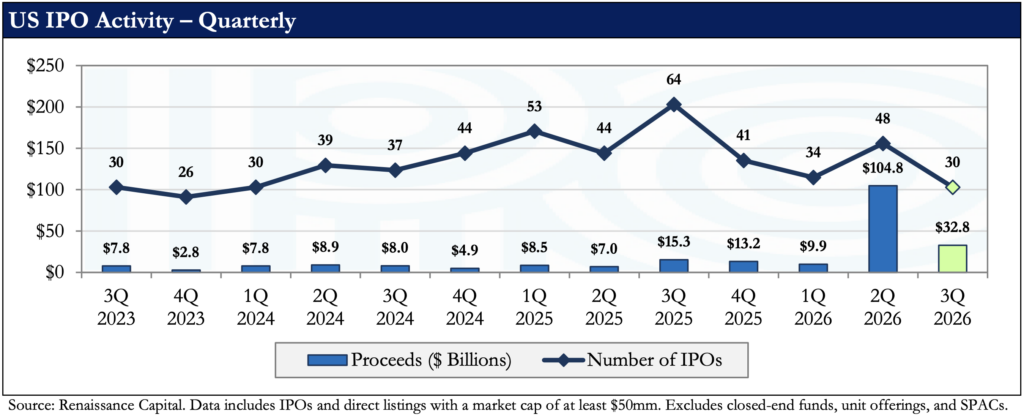
The chart shows how proceeds have clustered in a handful of very large listings. Many of these companies stayed private for years, so the S-1 can be the first time their audited financials become public. More filings may be on the way. Renaissance Capital counts 221 companies on file to go public and reports that Anthropic is currently expected to headline fourth-quarter activity, while OpenAI is now waiting until 2027. Until a company files publicly, though, investors typically have no S-1 to read.[i]
The Sections Investors May Want to Read First
S-1s follow a fairly standard order, from the prospectus summary through the financial statements. Investors don’t need to give every page equal attention. The sections below can answer many of the core questions about the business, its numbers, and who controls it.
Prospectus Summary and Risk Factors
The prospectus summary is the company’s own overview of its business, strategy, and key figures. It can be a useful starting point, but it is also the company’s best case for itself. The risk factors section is the counterweight. Much of it is standard language that appears in many filings, so investors may want to look for risks specific to the company. For example, artificial intelligence (AI) chipmaker Cerebras states in its April 2026 S-1 that “a substantial portion of our revenue has been, and is expected to continue to be, driven by a limited number of customers.”[ii] When a disclosure like this appears, the risk factors can help investors gauge how much revenue concentration could affect results if a major customer pulled back.
Use of Proceeds
This section explains how the company plans to use the money raised in the offering and also shows who is actually receiving that money. In its July 2026 S-1/A, an amendment to its previous S-1, Jersey Mike’s planned to sell about 13.8 million shares and use $295 million of its net proceeds to repay part of its outstanding notes. Selling stockholders were offering about 29.7 million shares, more than twice as many, and the company stated it would not receive any proceeds from those sales. In other words, most of the shares in the offering were set to come from existing holders, and the money from those shares would go to them, not into the business.[iii]
Management’s Discussion and Analysis (MD&A)
The MD&A is where the company explains its results in its own words. It is also where investors will typically find non-GAAP metrics, which adjust results calculated under generally accepted accounting principles (GAAP). Filings generally include a reconciliation between the two, and comparing them can show what is driving a headline number.
Cerebras shows why this can matter. The company reported net income of $237.8 million on revenue of $510 million in 2025, even though it posted a $145.9 million loss from operations. The difference came from about $390.7 million of other income. That included a change in the fair value of a forward contract liability, which the company removes from its non-GAAP measures.[iv] A profit driven by an item like this may say less about the core business than the operating line does.
Ownership and Voting Control
The ownership sections, including the description of capital stock, show who will control the company after the IPO. Some companies go public with a dual-class structure, in which one class of shares carries more votes than another, which may limit the influence of public shareholders. At SpaceX, Class B shares carry 10 votes each compared with one for Class A, and Elon Musk was expected to hold about 82% of the voting power, making SpaceX a “controlled company.”[v]
Underwriting and Shares Eligible for Future Sale
These sections describe the lock-up, an agreement in which existing shareholders agree not to sell their shares for a period after the IPO, typically 180 days but can last 6-12 months or longer. When a lock-up ends, a large number of shares may become eligible to trade at once, which could weigh on the stock price. Investors may want to note the lock-up length and any early-release terms.
What It May Mean for Private Market Investors
For investors who hold pre-IPO shares, directly or through a fund, the S-1 can answer practical questions. It typically shows how preferred shares will convert into common stock and which lock-up terms may apply to existing holders. It can also show how the expected IPO price compares with the company’s most recent private valuation. These details can shape when an investor may be able to sell and the shares potential worth.
Final Thoughts
An S-1 is long, but it follows a predictable structure. A handful of sections, from risk factors and use of proceeds to the MD&A, ownership, and lock-ups, can answer many investor’s core questions about the business, its numbers, and who controls it. Reading those sections with care may help private market investors understand what an IPO could mean for the companies they follow and the shares they hold.
Are you ready to invest in startups? Sign up for a MicroVentures account to start investing!
Want to learn more about investing in startups? Check out the following MicroVentures blogs to learn more:
- Going Public: Direct Listing vs IPO vs SPAC
- The Initial Public Offering Landscape: What Investors Need to Know About an IPO
- Benefits and Risks of Investing Pre-IPO
- From Private to Public: Understanding the IPO Process
Sources
- [i]renaissancecapital.com — https://www.renaissancecapital.com/review/3Q26USReview_Press.pdf
- [ii]sec.gov — https://www.sec.gov/Archives/edgar/data/2021728/000162828026025762/cerebras-sx1april2026.htm
- [iii]sec.gov — https://www.sec.gov/Archives/edgar/data/2127043/000119312526308260/ck0002127043-20260720.htm
- [iv]sec.gov — https://www.sec.gov/Archives/edgar/data/2021728/000162828026025762/cerebras-sx1april2026.htm
- [v]keeptrack.space — https://keeptrack.space/deep-dive/who-owns-spacex
Important disclosure
The information presented here is for general informational purposes only and is not intended to be, nor should it be construed or used as, comprehensive offering documentation for any security, investment, tax or legal advice, a recommendation, or an offer to sell, or a solicitation of an offer to buy, an interest, directly or indirectly, in any company. Investing in both early-stage and later-stage companies carries a high degree of risk. A loss of an investor’s entire investment is possible, and no profit may be realized. Investors should be aware that these types of investments are illiquid and should anticipate holding until an exit occurs.