OpenAI is an artificial intelligence (AI) company most commonly known for its AI chatbot, ChatGPT, and other products such as DALL-E and Sora. Founded with the mission of building artificial general intelligence (AGI) and ensuring it benefits all humanity in a safe way, OpenAI has evolved from its original form into a household name in the great AI race. In this blog, learn more about OpenAI’s history and milestones and OpenAI’s founding story.
OpenAI’s History and Milestones
OpenAI’s Founding Story
Initially founded in 2015 by Sam Altman, Elon Musk, Ilya Sutskever, and Greg Brockman as a non-profit, OpenAI recognized the power of artificial intelligence, and wanted to advance its powers in a safe, ethical, and beneficial way. The company was originally powered by $1 billion in funding from investors including Peter Thiel, Amazon Web Services, Infosys, and YC Research.
The non-profit structure was designed to make the company free from financial obligations to shareholders, freeing up its researchers to focus solely on AI development. OpenAI’s developers were also strongly encouraged to openly share their research as papers, blog posts, and open-source code to inspire collaborative efforts toward the common goal of ethical AI.
Capped-Profit Transition
After years of rapid experimentation and research, by 2019 OpenAI recognized that building AGI would not be possible through standard non-profit capital channels. To meet the anticipated financial needs of such a large project, OpenAI transitioned to a hybrid “capped-profit” model. This structure involved creating a for-profit subsidiary that was controlled by the original non-profit. Any profit for investors was capped at 100 times any investment, a design intended to balance capital attraction while still aligning with the company’s original mission.
Public Benefit Corporation Transition
After operating under the capped-profit model for years, OpenAI announced in late 2024 that it was re-examining its structure to help ensure that it could support its mission. In October 2025, OpenAI completed another restructure, converting its for-profit arm into a public benefit corporation and cementing its structure as a nonprofit with a controlling stake in its for-profit business. This restructure removed previous restrictions, allowing OpenAI to raise unlimited funds for AI development and opened the door for potential future public offerings.
OpenAI’s Products
OpenAI’s product suite uses its large language models (LLMs) for AI training and deployment, powering tools designed to generate written and spoken words, code, and images and videos.
GPT and ChatGPT
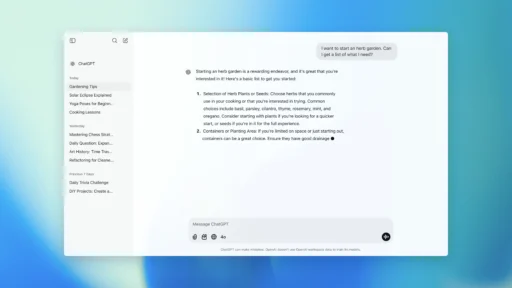
Generative Pre-trained Transformer (GPT) is the core of OpenAI’s offerings. Its first iteration was introduced in 2018 and OpenAI most recently released GPT-5 in August 2025. In November 2022, OpenAI launched ChatGPT, its AI chatbot based on GPT-3.5 at the time. ChatGPT rapidly became one of the fastest-growing applications in history, reaching 100 million users within two months.
DALL-E
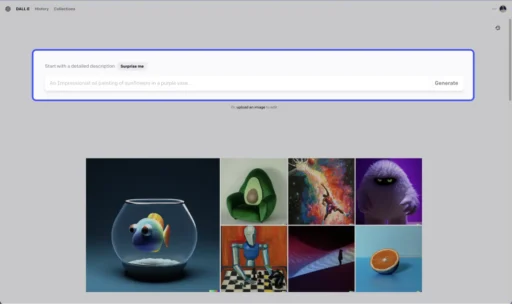
Unveiled in 2021, DALL-E is an AI system that creates and manipulates digital images from natural language descriptions. Its subsequent iterations, DALL-E 2 and DALL-E 3, have helped to advance the field of AI-generated art, with policies in place to decline requests that mimic the style of living artists.
Other Key Products
OpenAI has also released the following products:
- Whisper: An open-source machine learning model designed for automatic speech recognition and transcription
- Codex: An AI tool that assists developers by writing code in various programming languages
- Sora: An AI model capable of generating video clips from text descriptions
OpenAI’s Milestones
Over the years, OpenAI has reached numerous milestones in terms of traction, revenue, and awards. Some of its recent milestones are, but not limited to, the following:
- As of October 2025, OpenAI is laying the groundwork for a potential initial public offering (IPO) at a valuation up to $1 trillion that could come as soon as late 2026[1]
- Generated $4.3 billion in revenue in the first half of 2025, up 16% from all of 2024, and anticipates $13 billion in full year 2025 revenue, expecting revenue to grow to $200 billion by 2030[2]
- CEO Sam Altman reported that ChatGPT surpassed 800 million weekly users as of October 2025, about 10% of global adults
- Completed a $6.6 billion share sale at a $500 billion valuation in October 2025, making it the world’s most valuable privately held company[3]
Final Thoughts
OpenAI has positioned itself as a leader in artificial intelligence research and development. From its founding as a non-profit research lab to its evolution into a complex corporate structure, the company has become a household name making advancements in the AI space.
Are you ready to invest in startups? Sign up for a MicroVentures account to start investing!
Want to learn more about investing in startups? Check out the following MicroVentures blogs to learn more:
- MicroVentures Portfolio Company: Epic Games’ History and Milestones
- MicroVentures’ Portfolio Company: Anthropic’s History and Milestones
- MicroVentures’ Portfolio Company: Liquid Death’s History and Milestones
- MicroVentures Portfolio Company: ServiceTitan’s History and Milestones
- Mind Over Machine: Neuralink’s History and Milestones
[1] https://www.reuters.com/business/openai-lays-groundwork-juggernaut-ipo-up-1-trillion-valuation-2025-10-29/
[2] https://www.theinformation.com/articles/openais-first-half-results-4-3-billion-sales-2-5-billion-cash-burn
[3] https://www.cnbc.com/2025/10/02/openai-share-sale-500-billion-valuation.html
*****
The information presented here is for general informational purposes only and is not intended to be, nor should it be construed or used as, comprehensive offering documentation for any security, investment, tax or legal advice, a recommendation, or an offer to sell, or a solicitation of an offer to buy, an interest, directly or indirectly, in any company. Investing in both early-stage and later-stage companies carries a high degree of risk. A loss of an investor’s entire investment is possible, and no profit may be realized. Investors should be aware that these types of investments are illiquid and should anticipate holding until an exit occurs.
