
Robots are no longer confined to factory floors. They are moving into warehouses, hospitals, and even sidewalks, and investor attention has followed. As capital flows into the space, investors may want to understand which corners of the market are maturing and which remain early. In this blog, learn more about what is driving the robotics boom, the main segments of the market, and some considerations investors may want to weigh.
What’s Fueling the Robotics Boom
Several trends appear to be converging at once. Advances in artificial intelligence (AI) have given robots better perception and decision-making,[i] persistent labor shortages in areas like logistics and manufacturing have increased demand for automation, and the falling cost of sensors and components has made building robots more economical. Efforts to reshore production have added further momentum in some markets.[ii]
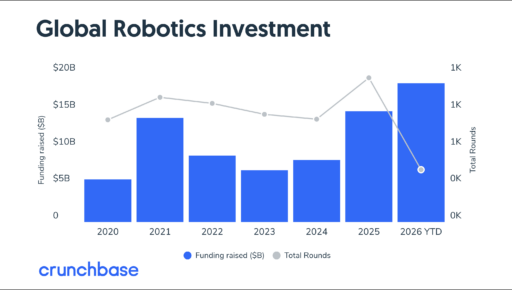
That combination has translated into a notable increase in funding. Robotics startups raised roughly $18.8 billion globally in the first half of 2026, already surpassing the estimated $15 billion raised across all of 2025.[iii]
Key Segments of the Robotics Market
The robotics boom is not a single market. It spans several segments that differ in maturity and risk, and understanding where a company sits can be an important part of evaluating an opportunity.
Industrial and Warehouse Automation
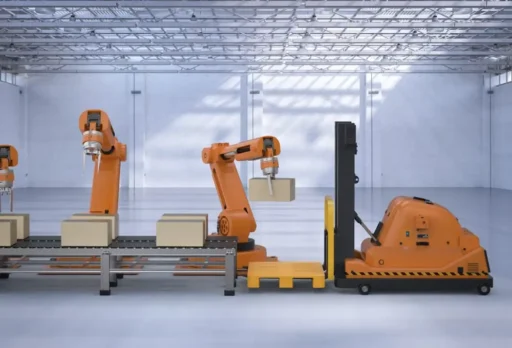
The industrial and warehouse automation segment is arguably the most established one. It typically covers robotic arms, automated guided vehicles, and warehouse fulfillment systems. Brain Corp, for example, develops artificial intelligence software that powers autonomous mobile robots used for tasks like floor cleaning and inventory scanning in retail and warehouse settings. Many of these use cases have a track record of adoption and potential cost-effectiveness that can make their economics somewhat easier to assess.
Humanoid and General-Purpose Robots
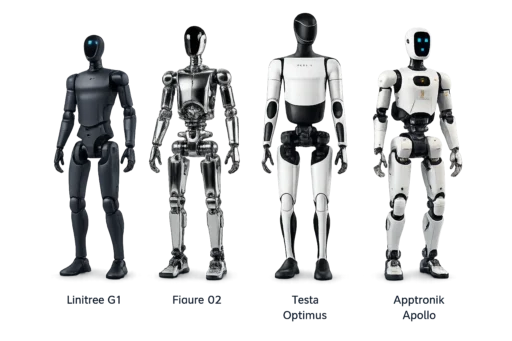
This segment has drawn considerable attention and capital. Figure AI and Apptronik, both humanoid robotics developers and MicroVentures portfolio companies, illustrate the activity here. In 2025, Figure AI raised over $1 billion in a financing round that valued it at around $39 billion.[iv] Earlier this year, Apptronik re-opened its Series A round due to an influx of investor demand and raised an additional $520 million that valued the company at $5.3 billion.[v] These robots are generally earlier in development, and investors may want to weigh the enthusiasm against the technical and commercial uncertainty that can accompany newer technology.
Healthcare and Surgical Robotics
Robotics has an established presence in areas like surgical assistance and hospital logistics. Newer entrants are moving into adjacent areas as well; Neuralink, for instance, has developed a surgical robot designed to implant its brain-computer interface devices. This is a segment that can involve longer regulatory pathways and, in turn, longer investment timelines.

Autonomous Mobility and Delivery
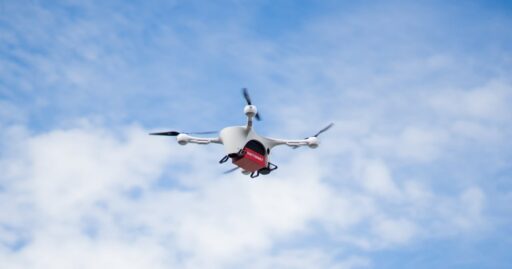
Robots are also being integrated in autonomous mobility and delivery, which includes self-driving systems and sidewalk or drone-based delivery. Zipline and Matternet are two players in this field, both operating drone delivery networks, with Zipline focused on autonomous delivery of items like medical supplies and consumer goods and Matternet building drone logistics networks for healthcare and other uses. The potential market for this segment is often described as large, but commercialization has generally been gradual, and regulation and safety can play a significant role. One key milestone has been approval to fly beyond visual line of sight (BVLOS). Zipline is among the operators that have received Federal Aviation Administration (FAA) authorization for BVLOS delivery flights, which can be an important step toward scaling drone operations.
What Investors May Want to Consider
Robotics companies often combine hardware and software, and building physical products is typically capital-intensive and can carry lower margins than software-only businesses. Investors may want to look at how efficiently a company plans to use its funding and how it intends to reach profitability. Timelines can also be long, and for late-stage private companies, exit time horizons can reach five to ten years, with robotics investments potentially falling beyond that range.
Competition and valuation are worth watching as well. Rapid funding growth can attract many entrants and, in some cases, push valuations ahead of fundamentals, so conducting careful due diligence on a company’s technology, customers, and financials may help investors separate durable businesses from those riding momentum. Because private shares are illiquid, investors may also want to consider how and when an exit might occur before committing capital.
Final Thoughts
The robotics boom spans several segments at different stages of maturity, from established industrial automation to earlier humanoid and autonomous systems. Strong funding growth has drawn investor interest, but capital intensity, long timelines, and valuation risk remain important considerations. Weighing where a company sits against those risks can help investors approach the space with clearer expectations.
Are you ready to invest in startups? Sign up for a MicroVentures account to start investing!
Want to learn more about investing in startups? Check out the following MicroVentures blogs to learn more:
- The Growth of Supply Chain and Logistics Tech
- Navigating Startup Exits
- Due Diligence Red Flags
- Going Public: Direct Listing vs IPO vs SPAC
- Developing Your Investment Thesis
Sources
- [i]insight.factset.com — https://insight.factset.com/the-robotics-surge-scale-private-capital-and-competitive-moats
- [ii]vaneck.com — https://www.vaneck.com/us/en/blogs/thematic-investing/reshoring-with-robotics-and-bridging-the-labor-gap/
- [iii]news.crunchbase.com — https://news.crunchbase.com/robotics/startup-venture-funding-surges-2026-data/
- [iv]finance.yahoo.com — https://finance.yahoo.com/news/figure-valued-39-billion-latest-131115237.html
- [v]techcrunch.com — https://techcrunch.com/2026/02/11/humanoid-robot-startup-apptronik-has-now-raised-935m-at-a-5b-valuation/
Important disclosure
The information presented here is for general informational purposes only and is not intended to be, nor should it be construed or used as, comprehensive offering documentation for any security, investment, tax or legal advice, a recommendation, or an offer to sell, or a solicitation of an offer to buy, an interest, directly or indirectly, in any company. Investing in both early-stage and later-stage companies carries a high degree of risk. A loss of an investor’s entire investment is possible, and no profit may be realized. Investors should be aware that these types of investments are illiquid and should anticipate holding until an exit occurs.