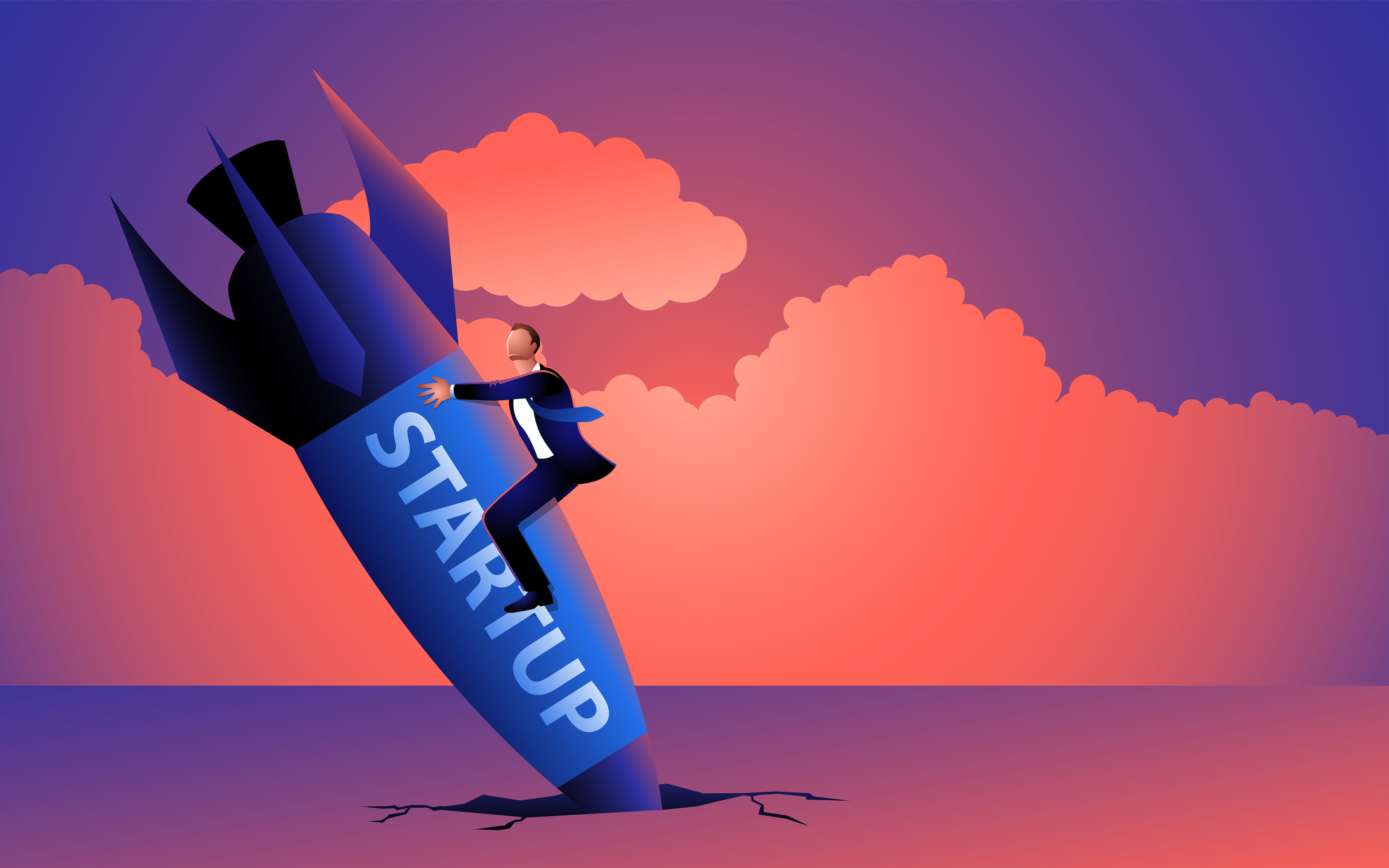
In the startup world, reaching a $1 billion valuation is considered the ultimate badge of success. But unicorn status is not a guarantee of survival. A surprising number of billion-dollar startups have collapsed entirely, taking investor capital down with them. Understanding who ended up in the unicorn graveyard, what went wrong, and why, may be one of the most valuable exercises a private market investor can do.
What Is a Unicorn, and How Common Is Failure?
The term “unicorn” was coined in 2013 by venture capitalist Aileen Lee to describe the statistical rarity of a privately held startup reaching a $1 billion valuation. Since then, the club has grown dramatically. As of March 2026, there were over 1,300 unicorn companies worldwide, collectively valued at more than $6.4 trillion.[i] With that growth has come a rise in high-profile failures. Research suggests that roughly 1 in 6 unicorns either wind down or fall below their peak valuation, and many analysts expect that figure to climb as companies minted during the 2020 and 2021 funding boom continue to mature. The stories behind those failures are often more instructive than the success stories.
Notable Unicorns That Collapsed
Theranos
Perhaps one of the most infamous unicorn failure of all time, Theranos was founded in 2003 by Elizabeth Holmes with the promise of revolutionizing blood testing through a device that could perform hundreds of tests from a single drop of blood. Theranos raised more than $700 million from venture capitalists and private investors, resulting in a $10 billion valuation at its peak.[iii] The problem: the technology never actually worked. Following intense scrutiny from media, medical authorities, and investors, the company faced charges of fraud by the Securities and Exchange Commission (SEC), and by 2018 Theranos ceased operations. Holmes was ultimately convicted of investor fraud and every dollar of equity invested became worthless.[iv]
WeWork
WeWork’s story is a masterclass in overvaluation and governance failure. The co-working company built a global empire of office spaces and convinced investors it was a technology company in the process. The New York-based firm raised over $22 billion and was valued at $47 billion at its peak. But its business model, which relied on signing long-term leases and subletting them short-term, was fundamentally mismatched. When the pandemic eroded demand for shared workspaces, the cracks became impossible to ignore. WeWork filed for Chapter 11 bankruptcy in November 2023, listing assets of over $15 billion against more than $18 billion in debt.[v] SoftBank, its largest backer, reported a cumulative loss of $18.6 billion on its investment.[vi]
Quibi
Quibi launched in April 2020 with $1.75 billion in backing and a bold premise: short-form premium video content designed exclusively for mobile phones. Within six months it had shut down. The company misread the market entirely, betting that commuters and travelers would pay for bite-sized content, then launching in the middle of a pandemic when nobody was commuting. It also refused to allow content to be viewed on televisions, a limitation users found frustrating. Quibi returned roughly $350 million to investors after liquidating its assets, meaning backers lost more than $1 billion on the venture.[vii]
FTX
FTX was founded in 2019 by Sam Bankman-Fried as a cryptocurrency exchange and quickly became one of the most celebrated names in crypto. In January 2022, FTX raised $400 million at a $32 billion valuation, making it one of the most valuable private companies in the world at the time. Less than a year later, it was gone. What first appeared to be an accounting issue turned out to be massive fraud: customer funds had been secretly transferred to Alameda Research, a trading firm Bankman-Fried also controlled, to fund risky trades and personal expenses.[viii] Within days of the revelation, customers withdrew billions, and FTX filed for bankruptcy in November 2022. Federal prosecutors described it as one of the biggest financial frauds in American history, and Bankman-Fried was convicted on all counts of fraud and money laundering in November 2023.[ix]
Jawbone
Founded in 1999, Jawbone was once one of the most well-funded consumer hardware startups in Silicon Valley. The company raised over $900 million from top-tier investors including Sequoia Capital, Andreessen Horowitz, and Kleiner Perkins, reaching a peak valuation of $3.2 billion in 2014. Its UP fitness trackers were early pioneers in the wearables market, but the company struggled with chronic product quality issues, manufacturing delays, and an inability to keep pace with competition from Fitbit and Apple Watch. Despite the massive capital behind it, Jawbone never achieved sustainable sales or profitability. By 2016, its valuation had been cut in half as investor confidence collapsed. In June 2017, Jawbone began liquidation proceedings, ranking at the time as one of the largest venture-backed failures in history.[x]
Convoy
Convoy was a Seattle-based digital freight startup founded in 2015 that promised to transform trucking the way Uber had transformed ridesharing. The company attracted high-profile backers including Jeff Bezos and Bill Gates, raising more than $1 billion and reaching a peak valuation of $3.8 billion. At its height, Convoy employed 1,500 people and counted major shippers like Home Depot and Unilever among its customers. But the company’s asset-light business model proved brittle when freight demand collapsed post-pandemic. Spot rates fell sharply, capital markets tightened, and Convoy’s revenue cratered to roughly half its 2022 levels within a year. In October 2023, CEO Dan Lewis sent a memo to employees informing them it was their last day, describing the situation as a “perfect storm” of a massive freight recession and a contraction in the capital markets.[xii] Its remaining assets were reportedly acquired by Flexport for just $16 million in late 2023.[xiii]
Olive AI
At the height of the digital health funding boom, few companies attracted more attention than Olive AI. The healthcare automation startup raised over $900 million from prominent investors including General Catalyst, Ascension Ventures, Oak HC/FT, and SVB Capital, reaching a peak valuation of $4 billion in 2021. Deployed across more than 900 hospitals in over 40 states, Olive appeared to be one of the most successful healthcare technology companies of its era. The reality was more complicated. Investigations revealed that the company’s AI relied heavily on manual intervention behind the scenes, and many customers reported receiving far less value than promised. After two rounds of significant layoffs in 2022 and 2023, Olive sold off its core business units and wound down operations in October 2023, with investors recovering only a fraction of the nearly $900 million put into the company.[xiv]
Hopin
When the pandemic forced the world’s conferences and gatherings online, Hopin emerged as the runaway winner. Founded in 2019, the virtual events platform raised over $1 billion and reached a peak valuation of $7.75 billion by August 2021, making it one of the fastest-growing startups in history. At its height, Hopin employed 1,200 people and was processing events for tens of thousands of customers worldwide. The problem was that its entire business model was built on a temporary shift in human behavior. As in-person events returned in 2022, demand for virtual events collapsed just as quickly as it had appeared. Hopin went through multiple rounds of layoffs and began selling off assets. In August 2023, the company sold its core virtual events platform to RingCentral for just $15 million, a decline of more than 99% from its peak valuation in under two years.[xv]
What These Failures Have in Common
Looking across unicorn failures, a few patterns emerge consistently.
Valuation disconnected from fundamentals
In each case, the headline valuation was built on a story rather than on underlying financial performance. Theranos had fraudulent technology. WeWork had a real estate business dressed up as a tech company. Quibi had assumptions about consumer behavior that were never validated. FTX had a business built entirely on the illusion of financial strength. Hopin’s billions in valuation were built almost entirely on pandemic-driven demand that vanished the moment the world reopened. When the story unraveled, there was nothing underneath to cushion the fall.
Governance and transparency failures
In the Theranos case, insufficient due diligence and fraudulent business practices led to losses for investors. WeWork’s governance issues were so severe that its original IPO attempt collapsed under scrutiny of its S-1 filing. At FTX, the administrator brought in to manage the bankruptcy described it as a complete failure of corporate controls, with no trustworthy financial information to be found. Olive AI’s customers reported receiving a fraction of the value the company had promised, with investigations revealing that its AI relied heavily on manual processes that contradicted its core pitch. A lack of independent oversight and basic accountability were warning signs that went ignored in the rush to participate in hot deals.
Growth at all costs
These companies consistently prioritized scale over sustainability. Theranos expanded into retail partnerships with major chains before its technology was ever proven to work. WeWork signed billions in long-term leases to fuel expansion. Quibi spent heavily on content before validating demand. FTX expanded aggressively into new markets, sponsorships, and investments while quietly misappropriating customer funds to do it. Jawbone burned through over $900 million chasing a hardware market it could never profitably serve. Convoy scaled to 1,500 employees and hundreds of millions in spending before its unit economics were ever proven. When capital stopped flowing or scrutiny increased, the underlying fragility of each business was exposed almost immediately.
What This Means for Private Market Investors
The lesson from the unicorn graveyard is not that billion-dollar startups should be avoided. It is that valuation alone tells you very little about the quality of an investment. A multi-billion dollar valuation that is untethered from real technology, real unit economics, or real governance is not a signal of safety; it may actually be a warning sign.
For private market investors, a few questions are worth asking before any investment regardless of a company’s headline valuation:
- Does the business model make sense without continuous outside funding?
- Are the financials audited or independently verified?
- Is the founding team being held accountable by an experienced, independent board?
- Is there a credible path to profitability, or is the story entirely dependent on future growth?
Understanding the cap table and due diligence red flags before investing remains essential. Unicorn status is a milestone, not a moat.
Final Thoughts
The unicorn graveyard is not a reason to avoid private market investing. It is a reminder that a billion-dollar valuation is not the same as a billion-dollar business. High valuations can attract attention, but they can also obscure risk. Some of the most important questions an investor can ask have nothing to do with a company’s headline number and everything to do with the fundamentals underneath it: Is the technology real? Is the business model sustainable? Are the right people being held accountable? For investors willing to look past the hype and ask the harder questions, the startup ecosystem remains full of opportunity.
Are you ready to invest in startups? Sign up for a MicroVentures account to start investing!
Want to learn more about investing in startups? Check out the following MicroVentures blogs to learn more:
- The Psychology of Investing: Navigating Investment Bias
- What’s It Worth? Navigating Inflated Startup Valuations
- How Tariffs and Trade Policy Impact Startup Investing
- Developing Your Investment Thesis
- Due Diligence Red Flags
Sources
- [i]cbinsights.com — https://www.cbinsights.com/research-unicorn-companies
- [ii]fortune.com — https://fortune.com/2021/05/07/what-percent-of-unicorns-fail/
- [iii]sgrlaw.com — https://www.sgrlaw.com/ttl-articles/sgr-holds-due-diligence-roundtable-on-lessons-learned-from-theranos-case/
- [iv]ebsco.com — https://www.ebsco.com/research-starters/technology/theranos
- [v]techcrunch.com — https://techcrunch.com/2023/11/06/wework-once-worth-47-billion-files-for-bankruptcy/
- [vi]fortune.com — https://fortune.com/2023/08/09/wework-going-concern-bankruptcy-risk-47-billion-valuation-adam-neumann/
- [vii]finance.yahoo.com — https://finance.yahoo.com/news/quibi-shuts-down-why-the-175-billion-streaming-app-failed-104534579.html
- [viii]thestreet.com — https://www.thestreet.com/crypto/investing/timeline-of-cryptocurrency-exchange-ftxs-epic-collapse
- [ix]ebsco.com — https://www.ebsco.com/research-starters/law/ftx-bankruptcy
- [x]cnbc.com — https://www.cnbc.com/2017/07/10/jawbones-demise-a-case-of-death-by-overfunding-in-silicon-valley.html
- [xi]fortune.com — https://fortune.com/2023/10/19/convoy-trucking-tech-startup-shuts-down-jeff-bezos-investor/
- [xii]geekwire.com — https://www.geekwire.com/2023/convoy-collapse-read-ceos-memo-detailing-sudden-shutdown-of-seattle-trucking-startup/
- [xiii]freightwaves.com — https://www.freightwaves.com/news/less-than-2-years-after-flexport-bought-convoys-tech-stack-its-being-sold-to-dat
- [xiv]fiercehealthcare.com — https://www.fiercehealthcare.com/health-tech/once-high-flying-unicorn-olive-ai-sells-two-key-businesses-winds-down-operations
- [xv]meetings.skift.com — https://meetings.skift.com/2023/08/09/hopin-events-and-session-products-sold-for-15-million/
Important disclosure
The information presented here is for general informational purposes only and is not intended to be, nor should it be construed or used as, comprehensive offering documentation for any security, investment, tax or legal advice, a recommendation, or an offer to sell, or a solicitation of an offer to buy, an interest, directly or indirectly, in any company. Investing in both early-stage and later-stage companies carries a high degree of risk. A loss of an investor’s entire investment is possible, and no profit may be realized. Investors should be aware that these types of investments are illiquid and should anticipate holding until an exit occurs.