When a company files to go public, it submits an S-1 registration statement with the U.S. Securities and Exchange Commission (SEC), a required public disclosure of the company’s business, financials, and risks that initiates a formal review process before shares can be sold to the public. In April 2026, Cerebras Systems Inc. (Cerebras) filed its S-1, offering investors a detailed look inside one of the more closely watched AI infrastructure companies in recent memory. The Cerebras IPO is planned on the Nasdaq Global Select Market under the ticker symbol “CBRS.” In this blog, learn more about the Cerebras IPO, what the Cerebras S-1 reveals, and what investors may want to consider.
Understanding the Cerebras IPO
Who Is Cerebras?
Cerebras is a Sunnyvale, California-based AI infrastructure company founded in 2016. The company’s core thesis is straightforward: in AI, speed matters. Cerebras argues that faster AI improves user engagement, lowers operating costs, opens new markets, and shortens iteration cycles for engineers and researchers. Its products are designed to deliver that speed for organizations training and running AI models at scale.
Cerebras delivers its solutions in several ways. Organizations that require full data and infrastructure control can purchase Cerebras AI supercomputers for on-premises deployments. Those seeking flexibility can access compute through Cerebras Cloud or through partner clouds, including Amazon Web Services (AWS) Marketplace, Microsoft Marketplace, IBM watsonx, and Hugging Face, among others.
The Technology: The Wafer-Scale Engine
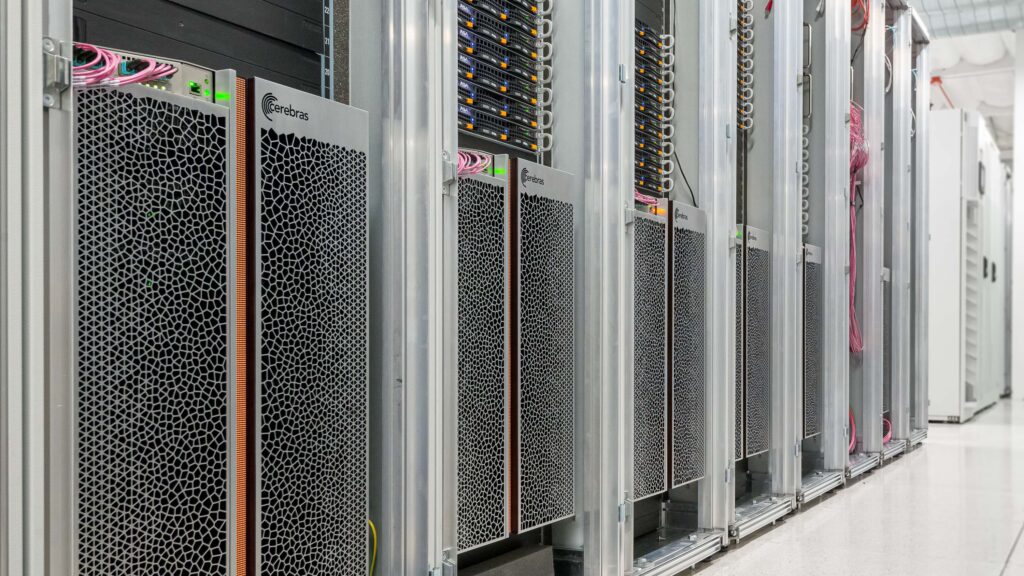
At the center of Cerebras’s product lineup is the Wafer-Scale Engine (WSE), which the company describes as the world’s first and only commercialized wafer-scale processor. Cerebras states that its inference platform delivers answers up to 15 times faster than leading graphics processing unit (GPU) solutions on prominent open-source models. It further claims that many customers achieve more than 10 times faster training time-to-solution compared to GPU systems of the same generation.

The core idea behind wafer-scale integration is keeping large amounts of compute and memory on a single piece of silicon, which Cerebras argues reduces data movement and improves speed. The company’s software stack is designed to make this architecture accessible, compiling standard PyTorch models directly to the WSE without requiring specialized programming. Investors evaluating technical claims in the filing may want to apply the same scrutiny discussed in our technical due diligence for non-technical investors blog, where understanding what questions to ask about feasibility and sourcing can be particularly useful.
Revenue and Financial Snapshot
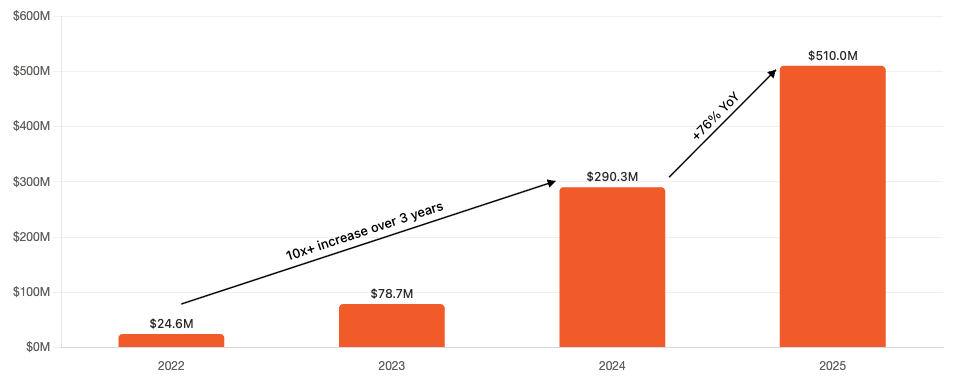
Cerebras has posted meaningful revenue growth in recent years. Revenue grew more than tenfold from 2022 to 2024, and reached $510.0 million in 2025, representing year-over-year growth of 76%. Gross margin also improved over the period, expanding from 12% in 2022 to 39% in 2025, which Cerebras attributes to improvements in the scale of its business and product mix.
Looking ahead, Cerebras also reported $24.6 billion in remaining performance obligations as of December 31, 2025, a significant portion of which is tied to its master relationship agreement (MRA) with OpenAI and is expected to be recognized over the next several years.
On the bottom line, the picture is more nuanced. The company reported generally accepted accounting principles (GAAP) net income of $237.8 million in 2025, compared to a net loss of $481.6 million in 2024. However, the 2025 net income figure was not driven by core operations, as Cerebras recorded a $363.3 million non-cash gain from the extinguishment of a forward contract liability. Excluding that gain and other non-operating items, the company reported a GAAP operating loss of $145.9 million in 2025. As with any pre-IPO company, investors may want to look at both GAAP and non-GAAP figures, and at operating results specifically, to form a more complete picture of underlying business performance.
Key Customer Relationships
Cerebras’s customer base spans hyperscalers, foundation model labs, AI-native and digital-native businesses, enterprises, and Sovereign AI initiatives.
Among its most notable relationships, Cerebras announced a multi-year deal with OpenAI valued at more than $20 billion in January 2026. Under the MRA, OpenAI committed to purchase compute capacity through 2030 and advanced Cerebras a $1 billion Working Capital Loan. Cerebras also issued OpenAI a warrant for approximately 33.4 million Class N shares that vest across performance milestones. In March 2026, Cerebras signed a binding term sheet with AWS under which AWS will install and operate Cerebras systems inside its own data centers, making AWS the first hyperscaler to integrate Cerebras compute directly into its cloud infrastructure.
Cerebras has also established strategic relationships with Group 42 Holding Ltd (G42), an Abu Dhabi-based technology group, and the Mohamed bin Zayed University of Artificial Intelligence (MBZUAI), an Abu Dhabi-based research university, both of which are connected to the UAE’s broader Sovereign AI strategy.
Cerebras reports meaningful expansion among its largest accounts. Cerebras’s top ten customers by year-to-date revenue through December 2025 increased their aggregate spend by approximately 80% within 12 months of their initial purchase, often including contracts for co-development.
Potential Risks Worth Noting
The S-1 outlines several risks investors may want to consider, though the risks highlighted below are not exhaustive and represent only a select view of what is disclosed in the filing.
Customer concentration is among the most notable. In 2025, revenue was anchored by two key customers, G42 and MBZUAI, at 24% and 62% of total revenue respectively. This represents a shift from 2024, when G42 alone accounted for 85% of revenue. While concentration has broadened somewhat, the overall customer base remains reliant on a small number of large accounts. The S-1 notes that reduced demand from key customers like OpenAI, G42, MBZUAI, or AWS, or a failure to meet MRA obligations, could harm the business. Both G42 and MBZUAI are also headquartered in the UAE, which may add geopolitical and export control exposure to the business.
The filing also discloses material weaknesses in internal controls over financial reporting for both 2024 and 2025, which the company has begun working to remediate. On the operational side, Cerebras outsources chip manufacturing to third-party suppliers and competes in a market dominated by well-capitalized incumbents like NVIDIA.
Capital Structure
Upon completion of the Cerebras IPO, the company plans to have three classes of common stock: Class A, Class B, and Class N. Class A shares, which are expected to be offered in the IPO, carry one vote per share. Alternatively, Class B shares carry 20 votes per share and are held by insiders, concentrating voting control with those who held securities prior to the offering. Class N shares are non-voting. Because this is a preliminary S-1, the share price range and total shares offered were not disclosed in the filing, as those details would typically appear in a later amended filing. Learn more about evaluating voting rights and capital structure in Navigating Startup Exits for additional context on how these dynamics can affect investor outcomes after an IPO.
Final Thoughts
Cerebras’s S-1 offers a detailed look at an AI infrastructure company with increased revenue growth, deep relationships with strategic partners, and a differentiated core technology in the WSE. The filing also surfaces meaningful considerations, including significant customer concentration in the UAE, a history of GAAP net losses, and a competitive market with well-capitalized incumbents. For investors, the S-1 is a starting point and may reward careful reading across its risk factors, financial statements, and business sections before drawing any conclusions.
Are you ready to invest in startups? Sign up for a MicroVentures account to start investing!
Want to learn more about MicroVentures portfolio companies? Check out the following MicroVentures blogs to learn more:
- Understanding Customer Acquisition Cost
- What to Look for in Investment Updates
- Understanding Startup Revenue Models
- When is a Startup No Longer a Startup
- Evaluating Go-To-Market Strategy
Important disclosure
The information presented here is for general informational purposes only and is not intended to be, nor should it be construed or used as, comprehensive offering documentation for any security, investment, tax or legal advice, a recommendation, or an offer to sell, or a solicitation of an offer to buy, an interest, directly or indirectly, in any company. Investing in both early-stage and later-stage companies carries a high degree of risk. A loss of an investor’s entire investment is possible, and no profit may be realized. Investors should be aware that these types of investments are illiquid and should anticipate holding until an exit occurs.