
Family Offices in Venture Capital: A Growing Force in Private Markets
When a startup announces a new funding round, the investor list may include more than venture capital firms and corporate investors. Increasingly, it can also include family offices, the private firms that manage the wealth of high-net-worth families. In this blog, learn more about what family offices are, how their role in venture capital has grown, and what their rise may mean for private market investors.
What is a Family Office?
A family office is a private firm set up to manage the investments and financial affairs of a wealthy family. A single-family office (SFO) serves one family, while a multi-family office (MFO) serves several. Unlike a venture capital (VC) firm, a family office typically invests its own family capital rather than raise it from outside investors.
Many family offices are created after a founder sells a business, which may help explain their comfort with startup risk. Of the new SFOs that data provider FINTRX added to its database in the first quarter of 2026, 57% were founded by entrepreneurs. FINTRX noted that these first-generation families tend to prefer direct deals, private equity, and VC, and take a more selective approach to traditional pooled funds.[i]
Venture Has Become a Core Part of the Family Office Playbook
Over the past decade, VC has become a central part of how many family offices invest. According to PwC’s Global Family Office Deals Study, VC made up 17% of family office investments in the second half of 2015. That share peaked at 38% in the first half of 2022 and stood at 31% in the first half of 2025.[ii]
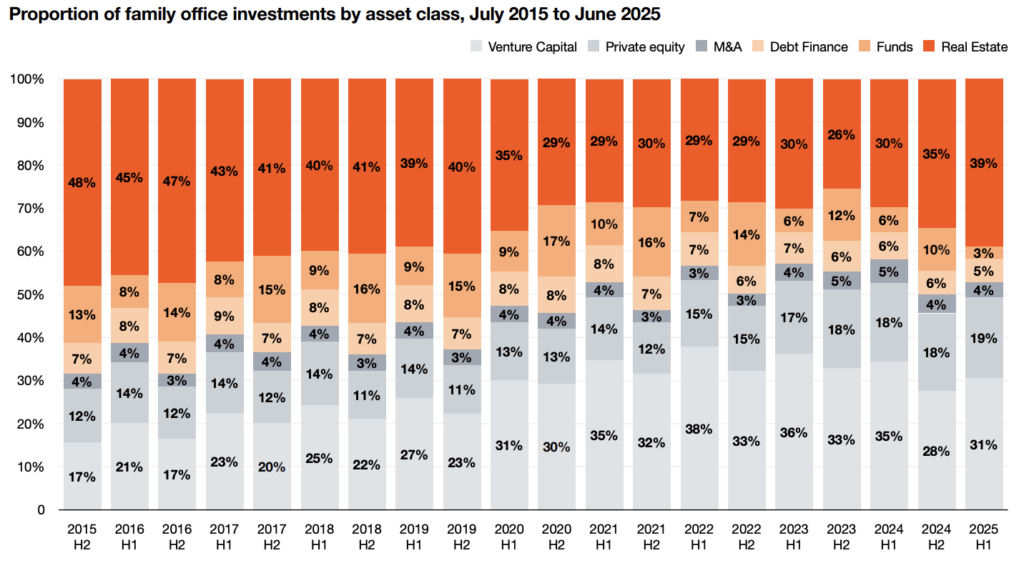
What may stand out most is how durable that share has been. Overall family office deal activity peaked in the second half of 2021 at 17,460 deals worth about $1.05 trillion, then fell to fewer than 7,200 deals in the first half of 2025, the lowest total in a decade, according to the same study. Even as the number of deals shrank, VC still accounted for nearly a third of family office investments. That could suggest many families view startups as a long-term allocation rather than a trend to chase.
Why Family Offices Are Drawn to Venture
That staying power may come down to how family offices are built. They can have a few structural advantages in startup investing. Because they generally manage their own capital, they typically don’t face the fixed fund timelines that can push traditional venture funds to seek exits within a set number of years. That patience can be useful at a time when many companies are staying private longer before going public.
Many families also bring operating experience from the businesses that created their wealth, which may help them evaluate founders and markets they already know. Some are also active in the secondary market, buying existing limited partner (LP) interests in private funds from other investors. According to Institutional Investor, 37% of family offices in J.P. Morgan Private Bank’s 2026 survey plan to increase private equity allocations, and a J.P. Morgan executive said families are “looking to buy LP stakes at discounts to get vintage year diversification.”[iii]
Where Family Offices Are Heading: Growth-Stage and Pre-IPO Deals
That interest is not limited to backing funds. Many family offices are investing in companies directly. Citi’s 2026 Global Family Office Report, based on a survey of 351 family offices, found that 75% engage in direct investing and 40% expect their direct investing activity to increase over the next 12 months, compared with 11% that expect to scale back or pause.[iv]
The stages they are targeting may be the most telling part. Growth-stage companies (Series C or D) were the top focus for direct investing, cited by 57% of respondents. Companies preparing for an initial public offering (IPO), often called pre-IPO companies, ranked second at 40%, nearly double the 22% from the prior year’s survey. Secondary transactions also drew 40%.
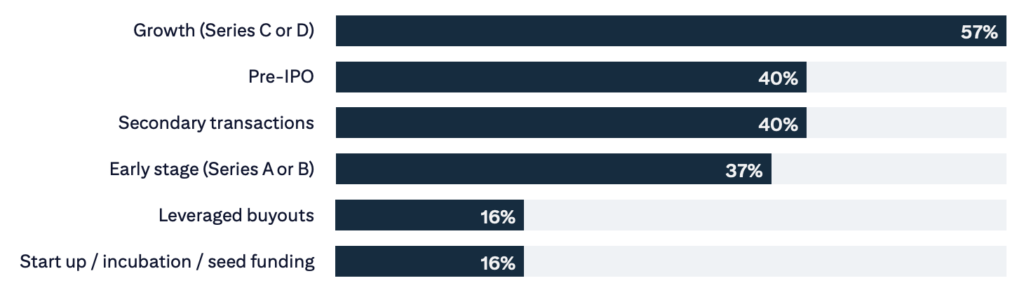
Artificial intelligence (AI) led the list of preferred sectors for direct investments, cited by 51% of family offices in the same report. Together, these findings suggest family offices may be concentrating their direct capital in late-stage private companies, where businesses typically have more operating history but have not yet reached the public markets.
What This May Mean for Private Market Investors
For individual investors, the growth of family office capital could cut both ways. More patient capital in growth-stage and pre-IPO rounds may help well-run companies raise money on their own timelines and could support longer private holding periods. At the same time, more well-funded buyers competing for the same late-stage and secondary opportunities may push up prices and make allocations harder to secure.
When evaluating a private company, investors may want to look at who sits on the cap table and what those investors’ time horizons appear to be. A funding round backed by long-term family capital may carry different expectations around exit timing than one led by a fund nearing the end of its life.
Final Thoughts
Family offices have become a lasting participant in venture capital, with startups making up nearly a third of their investments even through a sharp slowdown in deal activity. Many are now leaning further into direct deals, especially growth-stage and pre-IPO companies. For private market investors, understanding this patient and increasingly hands-on capital may help put funding rounds, valuations, and exit timelines in context.
Are you ready to invest in startups? Sign up for a MicroVentures account to start investing!
Want to learn more about investing in startups? Check out the following MicroVentures blogs to learn more:
- Inside Corporate Venture Capital: When Big Tech Invests in Startups
- How the Secondary Market Became a $106 Billion Opportunity in Startup Investing
- The Megaround Era: What Larger Funding Rounds May Mean for Private Market Investors
- The Denominator Effect: How Public-Market Drops Can Freeze Venture Fundraising
- Building a Diversified Startup Portfolio
Sources
- [i]prnewswire.com — https://www.prnewswire.com/news-releases/fintrx-q1-2026-family-office-report-shows-entrepreneurs-driving-growth-favoring-direct-private-equity-and-venture-capital-investments-302769801.html
- [ii]pwc.com — https://www.pwc.com/gx/en/services/family-business/assets/global-family-office-deals-study-2025.pdf
- [iii]institutionalinvestor.com — https://www.institutionalinvestor.com/article/secondaries-behind-family-office-charge-private-equity
- [iv]privatebank.citibank.com — https://www.privatebank.citibank.com/doc/family-office/2026-global-family-office-report.pdf
Important disclosure
The information presented here is for general informational purposes only and is not intended to be, nor should it be construed or used as, comprehensive offering documentation for any security, investment, tax or legal advice, a recommendation, or an offer to sell, or a solicitation of an offer to buy, an interest, directly or indirectly, in any company. Investing in both early-stage and later-stage companies carries a high degree of risk. A loss of an investor’s entire investment is possible, and no profit may be realized. Investors should be aware that these types of investments are illiquid and should anticipate holding until an exit occurs.