
For much of the last decade, growth was often the metric that mattered most to venture investors, sometimes even ahead of profitability, burn rate, or a clear path to break-even. In 2026, a return of fundamentals appears to be reshaping how investors underwrite new deals, though the shift is not landing evenly across every corner of the private markets. Learn more about what is driving this return of fundamentals, and where growth alone may still carry the day, in this week’s blog.
The Return of Fundamentals: Why Growth Alone May No Longer Be Enough
What “Fundamentals” Actually Means
When investors talk about a return of fundamentals, they generally mean less weight on how fast a company is growing, and more weight on how efficiently it is growing. That includes healthy margins, spending that is disciplined relative to the new revenue it produces, and sound unit economics, such as customer acquisition cost, that hold up without assuming an endless supply of cheap capital. A startup can be growing quickly and still be considered fundamentally weak if it burns large amounts of cash for every new dollar of revenue it brings in.
Public and private markets are not separate worlds, which is why this shift matters even for investors who never look at a public stock chart. Public valuations tend to set the benchmark that late-stage private rounds and eventual IPO pricing get measured against over time, so a change in how public investors price growth versus profitability can be an early signal for where private company valuations are headed. That is why the data below draws on both public market pricing and private company operating data.
The Data Behind the Shift
Software investors may want to look at the Rule of 40, a longstanding benchmark that adds a company’s revenue growth rate to its profit margin, with a combined score of 40 or higher generally considered a sign of balanced, capital efficient performance. According to PitchBook’s Q2 2026 enterprise SaaS analysis, companies meeting or exceeding that benchmark traded at a median 6.6x trailing-revenue multiple, compared with just 2.3x for companies below it. The same report found that median EBITDA margin is projected to reach 23.3% in 2026, up from 20% in 2025.[i] For investors, that gap can suggest that public markets are rewarding efficiency almost as much as they are rewarding growth rate itself. This is one of the clearest places where that public-to-private link shows up.
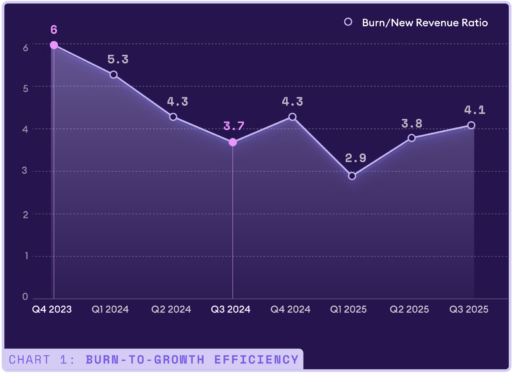
That same discipline shows up directly inside private companies, too, not just in how public investors price software stocks. Pilot’s chart shows the median burn-to-growth ratio among nearly 1,000 VC-backed startups falling from 6.0 in Q4 2023 to 3.7 by Q3 2024—and remaining disciplined as conditions improved. It provides direct evidence that the return of fundamentals is visible in startup operations: companies are generating considerably more growth from each dollar burned, rather than merely receiving lower valuations.[ii]
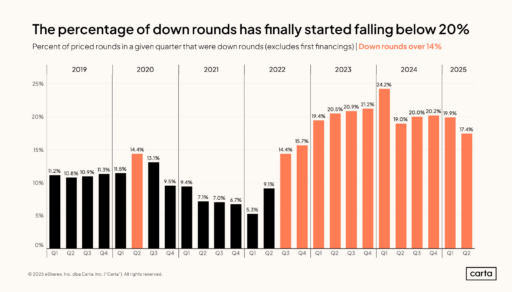
Private markets appear to be telling a similar story. Carta’s Q1 2026 State of Private Markets report found that the down-round rate fell to 11.4% in the first quarter, continuing a decline from a 2023 peak.[iii] Fewer down rounds alongside rising early-stage valuations could reflect a market where startups are generally expected to show more discipline before raising, rather than one still working through the down-round hangover from the 2022 reset.
Fundamentals for Some, Not for Others
So far, this looks like a story of broad, fairly uniform discipline. It is not quite that simple. The return of fundamentals may not apply evenly across every deal. The same Carta report noted that over 60 cents of every venture dollar invested in Q1 2026 went to AI companies, with foundational model companies alone accounting for a sizable share of that total.[iv] Some of the largest AI rounds are being priced at valuations that have little obvious connection to current revenue or unit economics, even as the rest of the market appears to be held to a higher bar.
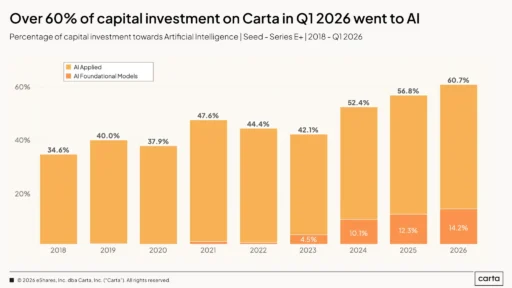
This can create something of a barbell effect. Late-stage startups outside of the AI mega-deal category may be facing more scrutiny of their growth versus profitability tradeoffs and their customer acquisition cost than in recent years, while a small number of AI-focused companies continue to raise at valuations that assume enormous future scale. Investors may want to ask which category a given deal actually falls into before assuming the broader return of fundamentals narrative applies across the board.
The IPO Bar Has Moved Too
The IPO market is one of the main paths private investors eventually rely on for an exit, which makes it worth watching closely. Public market investors appear to be applying similar scrutiny to companies preparing to go public. PwC’s Q2 2026 capital markets outlook described the IPO market as open to companies with appropriate scale, durable growth, a credible path to profitability, and the operational maturity to function as a public company from day one.[v] That is a notably more demanding checklist than the growth-only pitch that carried many 2021-era listings.
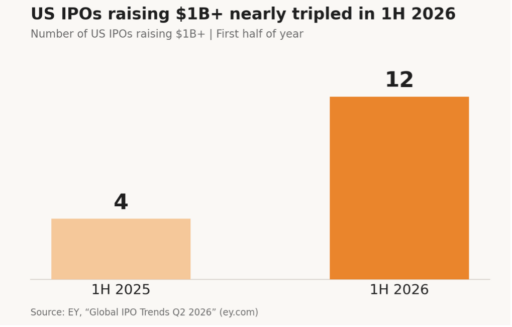
EY’s Q2 2026 Global IPO Trends report found that the number of U.S. IPOs raising $1 billion or more nearly tripled in the first half of 2026 compared with the same period the year before, even as the broader pool of IPO candidates stayed selective.[vi] That pattern points to a market rewarding fewer, larger, more mature companies, rather than one reopening broadly to early-stage growth stories. In other words, companies may be waiting longer to pursue an IPO, in part so they can point to more mature financials once they finally do.
What Investors May Want to Watch
Given this backdrop, and keeping the definition of fundamentals above in mind, investors may want to look past growth rate alone when evaluating a startup. A company’s Rule of 40 score, its trend in gross and net margins, and how its customer acquisition cost compares to customer lifetime value can offer a fuller picture of financial health than growth rate in isolation.
It may also be worth asking where a given startup sits relative to the AI mega-deal cohort. A company raising at a premium valuation largely on the strength of AI positioning could carry different return expectations, and different risks, than a company being priced on more traditional startup valuations and fundamentals. Understanding which dynamic applies can help investors calibrate their expectations for both risk and potential growth.
Final Thoughts
Pull these threads together, and the story of 2026 looks fairly consistent: public markets are pricing software efficiency, private companies are burning less cash per dollar of new revenue, down rounds are near multi-year lows, and the IPO bar has risen right alongside all of it. The exception is the concentrated pocket of AI-driven mega-deals, still being priced on scale and narrative more than on current unit economics. Investors may want to evaluate each opportunity on its own terms, keeping in mind which side of that divide, broad-based fundamentals or AI-scale narrative, it actually falls on.
Are you ready to invest in startups? Sign up for a MicroVentures account to start investing!
Want to learn more about investing in startups? Check out the following MicroVentures blogs to learn more:
- How the Secondary Market Became a $106 Billion Opportunity in Startup Investing
- What to Look for in Investment Updates
- Understanding Startup Revenue Models
- From Insight to Investment: Early-Stage Due Diligence
- The Megaround Era: What Larger Funding Rounds May Mean for Private Market Investors
Sources
- [i]pitchbook.com — https://pitchbook.com/news/reports/q2-2026-q2-2026-enterprise-saas-public-comp-sheet-saas-profits-strengthen-as-ai-disrupts-valuations
- [ii]cdn.prod.website-files.com — https://cdn.prod.website-files.com/60a5136f2c6c8e4fb3a130d9/699f51e9cbcc643fa004771a_Capital%20Efficiency%20Index%20-%20Pilot%202026.pdf
- [iii]carta.com — https://carta.com/data/state-of-private-markets-q1-2026/
- [iv]carta.com — https://carta.com/data/state-of-private-markets-q1-2026/
- [v]pwc.com — https://www.pwc.com/us/en/services/consulting/deals/us-capital-markets-watch.html
- [vi]ey.com — https://www.ey.com/en_us/insights/ipo/trends
Important disclosure
The information presented here is for general informational purposes only and is not intended to be, nor should it be construed or used as, comprehensive offering documentation for any security, investment, tax or legal advice, a recommendation, or an offer to sell, or a solicitation of an offer to buy, an interest, directly or indirectly, in any company. Investing in both early-stage and later-stage companies carries a high degree of risk. A loss of an investor’s entire investment is possible, and no profit may be realized. Investors should be aware that these types of investments are illiquid and should anticipate holding until an exit occurs.