
Startups Based on Hardware vs. Software Differ Significantly; Here’s How
Hardware and software startups are often discussed as part of the same technology ecosystem, but the realities of building and scaling these businesses can be quite different. The path from product development to commercialization can look dramatically different depending on whether a company is selling software, physical products, or a combination of both. MicroVentures breaks down how understanding these differences between hardware vs software startups can help investors evaluate opportunities and set realistic expectations around growth, capital needs, and risk.
Fundamental Differences Between Hardware vs. Software Startups
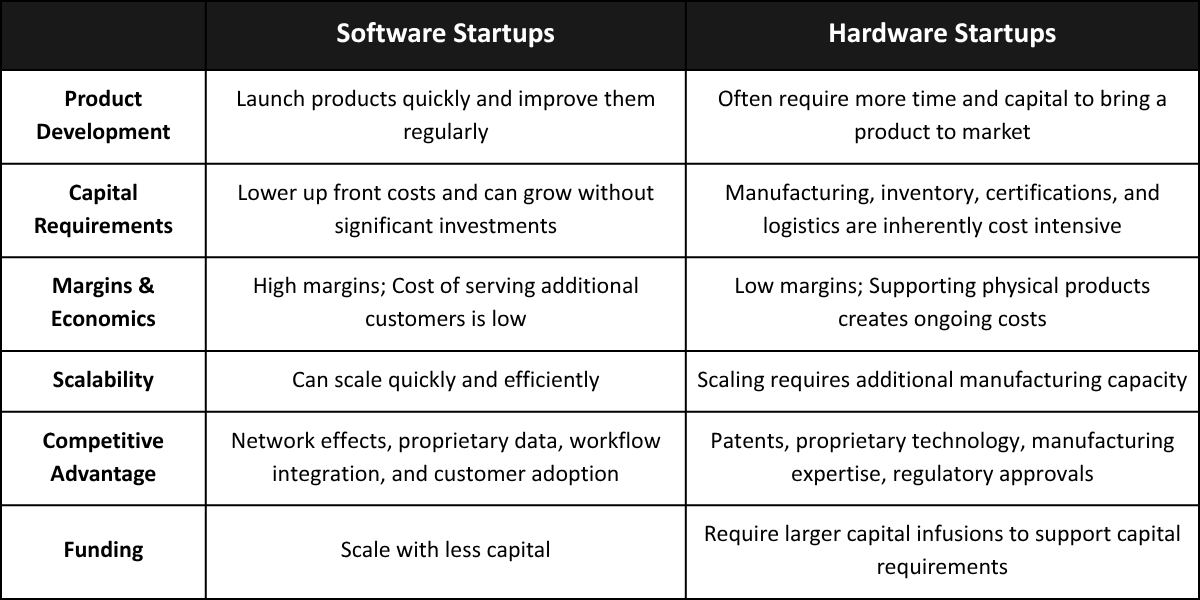
While both hardware and software companies are often driven by innovation, the way they build products, generate revenue, and scale their operations can vary significantly. These differences often influence everything from fundraising requirements to valuation multiples and exit timelines.
Here are some of the key differences investors must pay attention to.
Product Development and Time to Market
Software companies can often launch products quickly and improve them through regular updates and new features. Software and SaaS products typically reach general availability within 6 to 18 months, while consumer electronics can require one to three years to reach market as companies work through hardware tooling, supply chain requirements, and software integration.
Hardware startups generally have more steps between concept and commercialization, including prototyping, testing, manufacturing, and supply chain coordination before a product can reach customers. Because of this, hardware companies often require more time and capital before they begin generating meaningful revenue.
Capital Requirements
Building hardware is usually expensive from the outset. Founders may need to invest in tooling, manufacturing, inventory, certifications, and logistics well before products are sold at scale. Production delays can also increase funding needs and extend timelines.
Software businesses generally have lower upfront costs and can grow without making significant investments in physical infrastructure or inventory.
Margins and Economics
Software businesses are often known for their ability to generate high gross margins as they scale, with software and SaaS companies typically generating gross margins of 70% to 85%. Once the product has been developed, the cost of serving additional customers is typically low, allowing profitability to improve over time.
The economics of hardware businesses tend to look different, with hardware and component companies typically generating gross margins of 35% to 50%. Manufacturing, shipping, and supporting physical products create ongoing costs that can weigh on margins. That said, many hardware startups supplement product sales with recurring revenue streams such as subscriptions, software licenses, maintenance plans, or consumables, helping strengthen long-term economics.
Scalability
One of software’s advantages is the ability to scale efficiently. Adding new software customers has long been accepted as a near-zero marginal cost.
Hardware companies can also grow rapidly, but scaling usually requires additional manufacturing capacity, supplier coordination, inventory management, and logistics support. In many cases, growth depends just as much on manufacturing and logistics execution as it does on winning new customers.
Competitive Advantages and Defensibility
Software companies frequently build competitive advantages through network effects, proprietary data, workflow integration, and customer adoption. As products become embedded within a customer’s daily operations, switching to another solution can become increasingly difficult.
Hardware companies often build competitive advantages through different mechanisms. Patents, proprietary technology, manufacturing expertise, regulatory approvals, and integrated hardware-software ecosystems can all create meaningful barriers to entry. In some cases, replicating a physical product may require significant time, capital, and technical expertise.
Funding and Investor Expectations
Because software businesses can often scale with less capital, investors frequently focus on metrics such as annual recurring revenue, customer retention, growth rates, and unit economics.
Hardware startups generally require more capital to fund manufacturing, production capacity, inventory, and physical infrastructure. In climate tech, for example, hardware startups typically raise 20% to 50% more equity than software startups, with total funding needs approaching twice as much when non-dilutive capital is included.
Investors often evaluate hardware startups differently, placing greater emphasis on product readiness, manufacturing plans, customer demand, supply chain risks, and the capital required to reach commercial scale. While hardware companies may require more capital overall, longer development and commercialization cycles can result in more time between individual raises. As a result, while fast-growing software companies may raise funding annually, hardware startups can go two to three years between rounds as they work toward key technical and commercial milestones.
Key Considerations
Both hardware and software startups can create value, but each comes with a different set of opportunities and challenges.
Hardware Execution Risk
Even strong products can encounter obstacles during manufacturing and distribution. Supply chain disruptions, production delays, quality control issues, and rising input costs can all affect growth and profitability.
Software Competition
Software businesses can scale quickly, but many markets are highly competitive. Customer acquisition costs, retention rates, and product differentiation often play a major role in determining long-term success.
The Rise of Hybrid Models
An increasing number of startups blur the line between hardware and software. Rather than relying solely on product sales, these companies pair physical products with recurring software or service revenue. This approach can create stronger customer relationships, improve revenue visibility, and blend some of the advantages of both business models.
Investors Should Weigh Options Carefully
Hardware and software startups solve different problems and operate under different constraints. As a result, they often require different approaches to product development, scaling, and capital formation. Understanding those differences can help investors better assess opportunities and set expectations around growth, risk, and potential returns.
Are you ready to invest in startups? Sign up for a MicroVentures account to start investing!
Want to learn more about investing in startups? Check out the following MicroVentures blogs to learn more:
- Investing in Second-Time Founders
- Understanding Voting vs Non-Voting Shares
- Developing Your Investment Thesis
- Learning From Failed Startups
Important disclosure
The information presented here is for general informational purposes only and is not intended to be, nor should it be construed or used as, comprehensive offering documentation for any security, investment, tax or legal advice, a recommendation, or an offer to sell, or a solicitation of an offer to buy, an interest, directly or indirectly, in any company. Investing in both early-stage and later-stage companies carries a high degree of risk. A loss of an investor’s entire investment is possible, and no profit may be realized. Investors should be aware that these types of investments are illiquid and should anticipate holding until an exit occurs.